 English
 Español
 русский
 中文简体
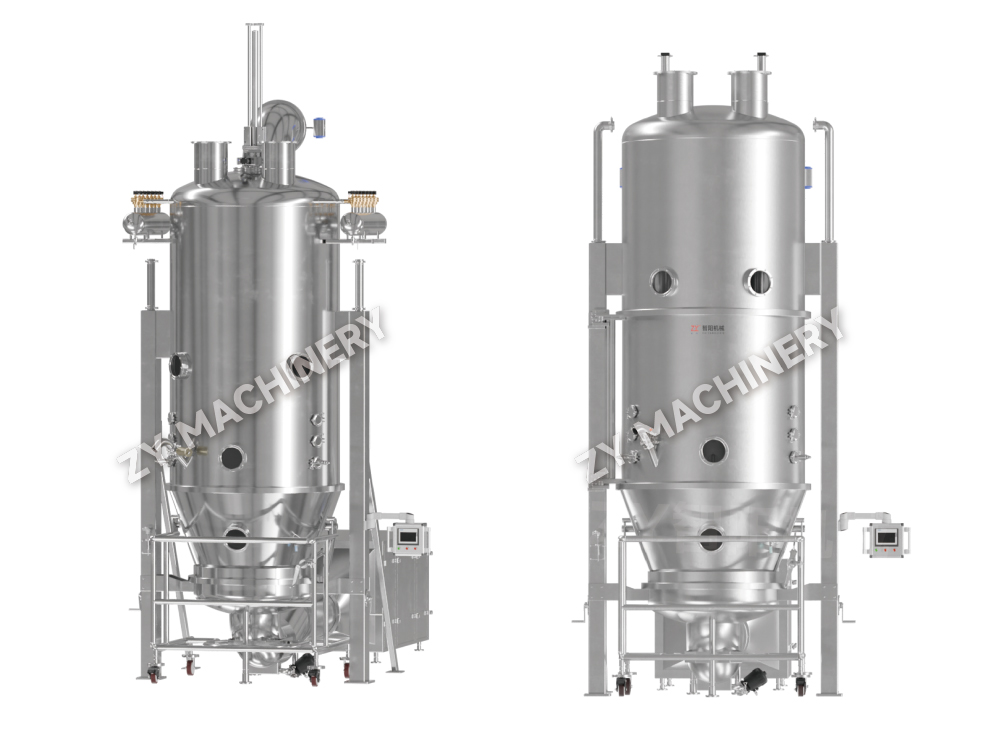
中文简体FL-B Fluid-bed Granulation & Drying Machine (One-Step Granulator)
The FL-B Fluidized Bed Granulation & Drying Machine is designed for pow.....

Content
Pharmaceutical vacuum drying equipment achieves rapid, low-temperature drying that preserves API stability, reduces residual solvents to below regulatory limits (typically ≤0.5% or 500 ppm), and enables up to 95% solvent recovery. Data from industrial scale-ups show that switching from conventional hot-air ovens to vacuum dryers reduces drying temperatures by 30–50°C, cuts processing time by 40–60%, and ensures uniform residual moisture distribution with a relative standard deviation (RSD) below 5%. Selecting the right dryer type—static tray, rotary, or agitated conical screw—requires matching material properties, batch scale, and containment needs. This article delivers specific performance metrics and cGMP design criteria to guide your decision.
Vacuum drying operates by reducing the absolute pressure above a wet solid, which lowers the boiling point of solvents and accelerates mass transfer without thermal degradation. For example, water boils at 45°C at 100 mbar absolute versus 100°C at atmospheric pressure, allowing heat-sensitive active pharmaceutical ingredients (APIs) to be dried safely. The enhanced vapor pressure gradient inside the dryer doubles the drying rate compared to forced-air ovens.
In a study drying a proprietary antifungal API from a wet cake with 35% isopropyl alcohol (IPA), a vacuum conical screw dryer reduced residual IPA from 8.2% to 0.12% (1200 ppm) in 6 hours at 45°C jacket temperature and 80 mbar. The same material dried in a conventional tray oven at 60°C required 22 hours to reach 0.5% residual solvent and showed a 12% increase in related substances due to oxidation. Vacuum dryers with inert gas purging (e.g., nitrogen) completely prevent oxidative degradation.
Furthermore, closed-loop vacuum systems condense and recover evaporated solvents. For a batch processing 500 kg of wet product with 300 kg of acetone, the recovery system captured 285 kg (95% recovery), reducing solvent purchase costs and VOC emissions. The recovered solvent met internal purity specs (>99.5%) and was reused.
Choosing the correct vacuum drying technology directly impacts batch yield, processing time, and operating cost. The table below provides concrete data for three common equipment classes based on real production installations.
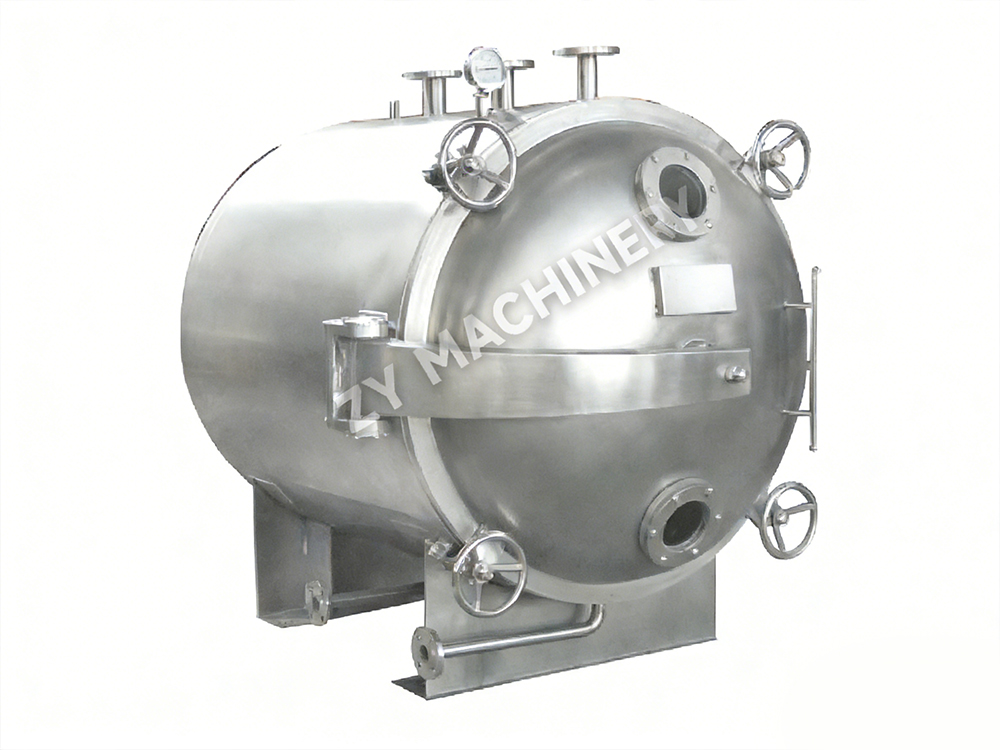
| Parameter | Vacuum Tray Dryer (VTD) | Rotary Vacuum Dryer (RVD) | Conical Screw Dryer (CSD) |
|---|---|---|---|
| Typical batch size (kg) | 10 – 200 | 50 – 2000 | 20 – 3000 |
| Heat transfer coefficient (W/m²·K) | 5 – 20 | 30 – 60 | 50 – 150 |
| Drying temperature range (°C) | 30 – 85 | 20 – 120 | 10 – 150 |
| Typical residual moisture (%, w/w) | 0.1 – 0.5 | 0.05 – 0.3 | 0.02 – 0.2 |
| Relative drying time (normalized to VTD=1) | 1.0 | 0.55 | 0.35 |
| Solvent recovery efficiency (%) | 70 – 85 | 85 – 95 | 90 – 97 |
Conical screw dryers offer the highest heat transfer and lowest residual moisture due to continuous agitation and full jacket coverage. For example, an RVD processing 800 kg of a fluffy intermediate achieved a final moisture of 0.25% in 12 hours, while the same batch in a CSD reached 0.08% moisture in 4.5 hours, with a 40% reduction in nitrogen consumption.
Regulatory compliance for pharma vacuum drying equipment requires validated designs that prevent cross-contamination, ensure cleanability, and maintain process integrity. Key design features with specific validation limits include:
A recent installation of a 1200L conical screw dryer at a European API facility passed all validation protocols: leak rate 0.003 vol%/h, temperature uniformity ±1.2°C, and residual moisture RSD 3.8% across 12 sampling points, well below the acceptance criterion of 6%.
Three interdependent parameters govern drying performance. Their optimization can reduce batch time by 30-50% without compromising quality.
Start with moderate vacuum (200-300 mbar) to avoid violent bumping when free solvent evaporates. After 1-2 hours, ramp to final vacuum (20-50 mbar). For an API wet cake containing 40% ethyl acetate, stepped vacuum reduced loss of fines from 4.2% to 0.7% compared to immediate full vacuum.
Set jacket temperature 10-15°C below the degradation onset of the API. For thermolabile products (degradation Tonset = 60°C), limit jacket to 45°C and use vacuum as low as 20 mbar to maintain a 15°C driving force for solvent evaporation. Real-time product temperature sensors prevent local overheating.
In agitated dryers (RVD, CSD, paddle dryers), intermittent mixing improves homogeneity without over-shearing. A typical protocol: 5 rpm for 2 min every 15 min during the constant-rate period, then continuous 3 rpm during the falling-rate period. This sequence reduced friability of a soft granule from 8.2% to 2.1% while maintaining a drying time of 5 hours. For static VTDs, turn the trays (rotate or flip) every 2 hours to minimize moisture gradients.
Applying these optimizations to a 250 kg batch of an amorphous API cut total drying time from 16 hours to 9 hours while achieving residual n-heptane < 400 ppm, well below ICH Q3C limit of 5000 ppm.
A contract manufacturing organization (CMO) needed to dry a high‑potency API wet cake (batch size 300 kg) containing 35% tetrahydrofuran (THF) with water content 12%. The API degraded above 55°C and was extremely hygroscopic. Using a vacuum paddle dryer with a jacketed trough and central agitator, the following protocol was executed:
Final assay: residual THF = 0.08% (800 ppm), water content = 0.12% (1200 ppm), and degradation products were below 0.1%. The total drying cycle of 8 hours compared favorably to 24 hours projected for a vacuum tray dryer. Solvent recovery via a chilled condenser (coolant at -10°C) reclaimed 95 liters of THF with 99.2% purity, offsetting operational costs by 18% per batch. The CMO subsequently standardized on vacuum paddle dryers for all THF-wet batches.
Want to stay up to date?
Contact us via the email address below.
Don't worry about spam. We hate it too!
Mobile Client

Video Account
Phone:+86-15161130178
Tel:+86-519-88674267
Email:czzy188@163.com
Phone:+86-15161132798
Email:zy@zy-drying.com

WeChat ID

Copyright 2026 Changzhou Zhiyang Machinery Equipment Co., Ltd. All Rights Reserved  Oral Solid Dosage Equipment Manufacturer