English
 Español
 русский
 中文简体
中文简体



Industry Knowledge
Wet Mass Condition Determines Extrusion Stability
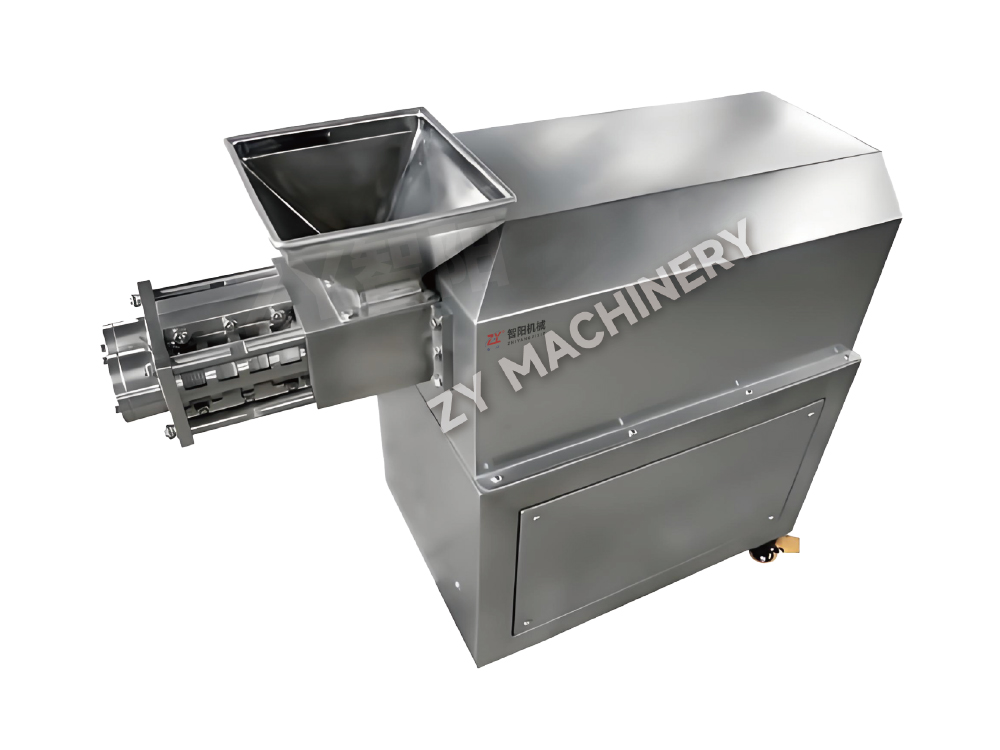
For Extrusion Granulators, the most influential upstream variable is often not extrusion pressure itself, but the condition of the wet mass entering the barrel. Binder distribution, moisture uniformity, mixing time, and wetting sequence determine whether material flows continuously or alternates between blockage and weak strand formation.
Practical signs observed during trials
| Observation | Possible Process Cause | Trial Adjustment |
|---|---|---|
| Strands break immediately after discharge | Insufficient plasticity or uneven binder distribution | Review liquid addition rate and wet mixing time |
| Die holes intermittently block | Over-wet mass, agglomerated powder, or poor pre-mixing | Check moisture level and dry blend uniformity |
| Strand diameter fluctuates | Feed inconsistency or non-uniform wet mass density | Stabilize feeding and confirm batch mixing consistency |
A stable, uniformly plasticized wet mass usually reduces downstream correction work more effectively than increasing extrusion force. At ZY, we use material trials to connect mixing parameters with extrusion behavior before proposing a production configuration.
Choosing Die Openings Around the Target Granule Route
Die opening selection should be based on the required downstream result rather than strand appearance alone. Circular die holes are commonly selected when extrudates will enter a spheronization stage, while shaped openings may be relevant where strand geometry or drying behavior has a functional purpose.
Buyer-side questions worth confirming before equipment selection
- Is the product expected to remain as an extrudate, or will it be rounded in a spheronizer?
- What particle size range is acceptable after drying and screening?
- Does the formulation contain sticky, abrasive, heat-sensitive, or highly elastic ingredients?
- Will multiple products require interchangeable die plates or easy cleaning between batches?
Smaller openings may support finer granule targets, but they can also increase resistance and make poor wet-mass preparation more visible. Larger openings may improve throughput potential while producing strands that need different spheronization and drying conditions.
Our ZY engineering approach is to match die selection with material characteristics, expected capacity, and the intended downstream route rather than treating the die plate as an isolated accessory.
Extrusion and Spheronization Should Be Evaluated as One Process Link
When round granules or pellets are required, extrusion performance cannot be judged only by whether continuous strands are produced. The strand must also have suitable strength, moisture condition, and plasticity for controlled breakage and rounding during spheronization.
How extrusion output influences pellet quality
| Extrudate Condition | Likely Spheronization Effect | Evaluation Point |
|---|---|---|
| Too dry or brittle | Higher fines generation and irregular particles | Binder level and liquid distribution |
| Too soft or sticky | Agglomeration or oversized wet masses | Moisture level and wet mixing end point |
| Consistent and plastic | More controllable rounding and size distribution | Repeatability across batches |
For pellet production, acceptable extrusion output means strands that process well in the next step, not merely strands that exit the die. ZY can integrate extrusion and spheronization considerations into one practical process route.
What to Verify Before Moving from Trial Batches to Production
Scale-up should preserve the material state that produced acceptable granules during development. A larger Extrusion Granulator does not automatically reproduce laboratory results unless mixing uniformity, liquid addition, wet mass residence time, extrusion load, discharge behavior, and downstream handling are considered together.
Useful records for equipment and process confirmation
- Document the dry mixing sequence, binder preparation method, liquid addition time, and wet mixing duration.
- Record strand continuity, surface condition, die blockage tendency, motor load trend, and discharge temperature where relevant.
- Compare wet granule size distribution, spheronized particle shape where applicable, drying response, and final yield after screening.
- Confirm cleaning access, product changeover requirements, material-contact construction, and available installation space.
For pharmaceutical, nutraceutical, veterinary, biotechnology, food powder, and additive applications, the preferred configuration may differ substantially even at similar nominal capacities. Product behavior during wetting and extrusion is the more reliable design basis.
At ZY, we develop equipment proposals around testable process parameters and site implementation conditions, helping buyers move from formulation trials to a workable granulation line with fewer scale-up assumptions.