English
 Español
 русский
 中文简体
中文简体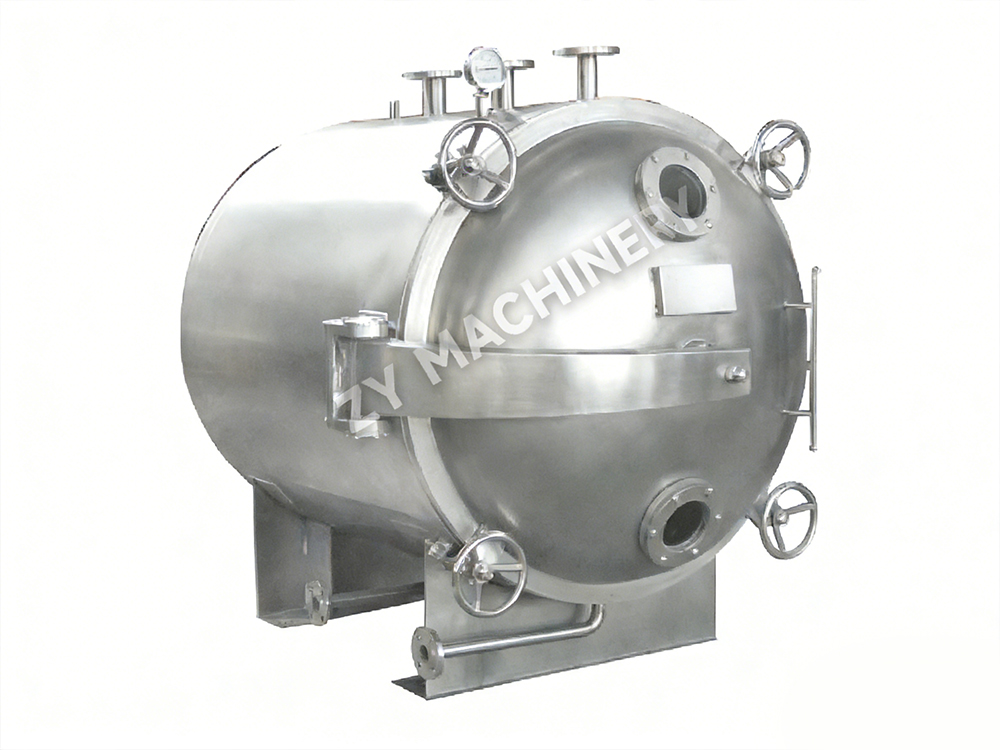

Industry Knowledge
Choosing a Drying Route for Heat-Sensitive Pharmaceutical Materials
For pharmaceutical powders, granules, extracts, and intermediate materials, drying performance should not be evaluated only by how quickly moisture is removed. Temperature exposure, oxygen contact, solvent behavior, particle structure, and discharge condition can all influence the downstream process.
What should be confirmed before selecting equipment?
- Whether the material is sensitive to heat, oxidation, prolonged residence time, or shear.
- Whether the removed liquid is water, ethanol, another organic solvent, or a mixed solvent system.
- Whether the required endpoint is based on moisture content, residual solvent, flowability, or product stability.
- Whether containment, cleanability, solvent recovery, or explosion-protection measures are required.
Because Pharma Vacuum Drying Equipment operation lowers the boiling temperature of liquids, it can reduce unnecessary thermal stress during drying. This is particularly useful when an active ingredient, excipient blend, herbal extract, or high-value intermediate must retain its intended characteristics after moisture or solvent removal.
At ZY, we usually begin with material properties and target residual levels rather than selecting a dryer only from nominal batch capacity. A suitable process route should protect the material while remaining practical for cleaning, loading, discharge, and validation.
Vacuum Level, Product Temperature, and Drying Endpoint Must Be Evaluated Together
A deeper vacuum does not automatically mean a better drying result. During pharmaceutical drying, vacuum level, jacket temperature, product temperature, agitation condition, condenser performance, and drying time work as one system. Improper balance may cause surface hardening, foaming, material entrainment, uneven residual moisture, or extended cycle times.
| Process Factor | Practical Effect | Buyer Evaluation Point |
|---|---|---|
| Vacuum stability | Influences evaporation consistency and batch repeatability | Confirm sealing reliability, vacuum control method, and leakage management |
| Product temperature | Determines thermal exposure of sensitive ingredients | Confirm monitoring position and temperature control accuracy |
| Condenser capacity | Affects vapor handling and solvent recovery performance | Match capacity to solvent type and peak evaporation load |
| Endpoint determination | Reduces over-drying or incomplete drying risk | Define acceptable moisture or residual solvent limits before purchase |
Stable vacuum control and reliable product-temperature monitoring are often more important than pursuing the lowest possible pressure. For scale-up projects, buyers should request test data or process assumptions that show how the proposed parameters relate to product quality and cycle time.
Residual Solvent Handling and Cleanability Affect Long-Term Usability
When drying pharmaceutical materials containing organic solvents, the equipment should be considered as part of a complete handling system rather than as an isolated vessel. Vapor collection, condensation, vacuum protection, discharge containment, and cleaning access directly influence daily operation and compliance work.
Important engineering considerations for solvent-containing batches
- A condenser and receiver arrangement suitable for the expected solvent load and recovery objective.
- Material-contact surfaces selected for corrosion resistance and cleaning compatibility.
- Seals, filters, and vacuum-line protection designed to reduce contamination and maintenance frequency.
- Appropriate safety configuration when flammable or volatile solvents are involved.
Why cleaning design matters
Drying equipment may process multiple formulations or campaigns. Dead corners, difficult-to-access discharge areas, unsuitable filter arrangements, or poor surface finishing can increase cleaning effort and cross-contamination risk. Buyers should therefore review internal accessibility, cleaning method, surface requirements, gasket arrangement, and documentation support during equipment evaluation.
ZY integrates drying, recovery, containment, and cleaning requirements into the equipment discussion so that the proposed configuration is workable in actual pharmaceutical production rather than only acceptable on a specification sheet.
From Laboratory Verification to Production-Scale Vacuum Drying
Laboratory or pilot testing can reduce uncertainty before purchasing production equipment. For a new formulation or sensitive material, testing should help identify realistic operating windows, not simply prove that drying is possible.
Useful results to collect during trials
- Initial and final moisture content or residual solvent data.
- Product temperature trend under selected vacuum and heating conditions.
- Drying duration required to reach the defined endpoint.
- Material behavior during drying, such as agglomeration, foaming, sticking, dusting, or difficult discharge.
- Post-drying characteristics relevant to downstream processing, including flowability, appearance, particle condition, or stability indicators.
Scale-up should also consider changes in heat-transfer area, bed depth, vapor generation rate, Pharma Vacuum Drying Equipment capacity, and loading or discharge arrangements. A successful laboratory endpoint cannot be transferred directly to production without evaluating these engineering differences.
With laboratory, pilot, and production-scale process thinking, ZY supports customers in translating test observations into practical equipment parameters and production layouts. We focus on achieving reliable drying results with reasonable cycle efficiency and implementation cost.
For projects involving specialized powders, extracts, intermediates, or solvent-bearing materials, ZY can align the dryer configuration with upstream preparation and downstream handling needs to help build a more consistent production route.