English
 Español
 русский
 中文简体
中文简体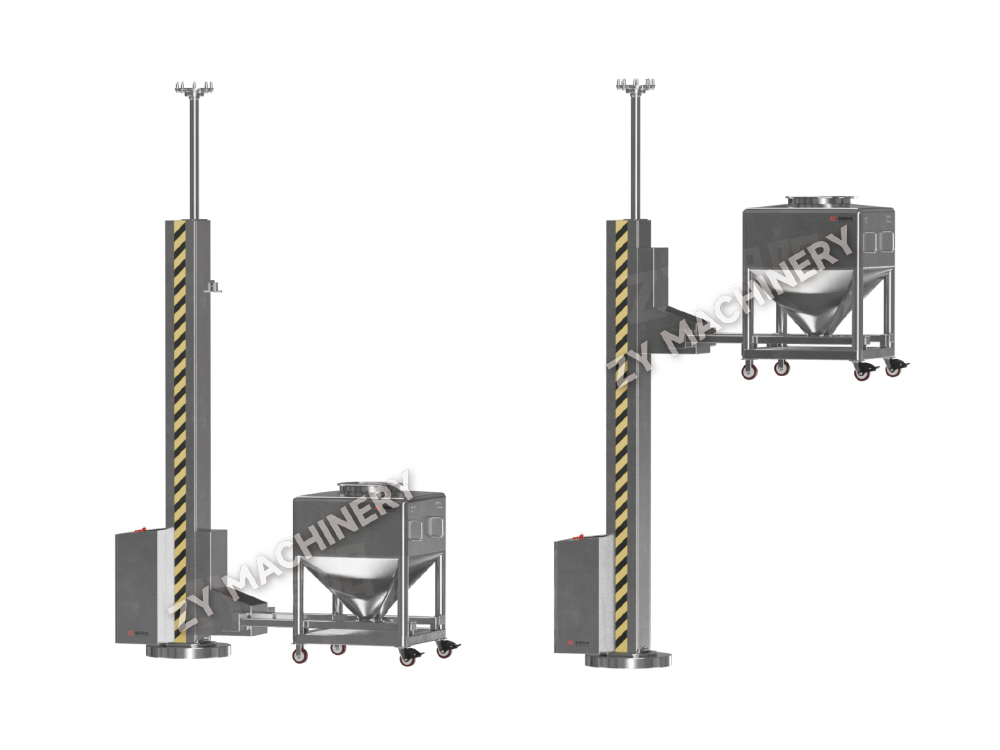


Industry Knowledge
How to Prevent Segregation During Lifting and Conveying Before Small-Batch Mixing
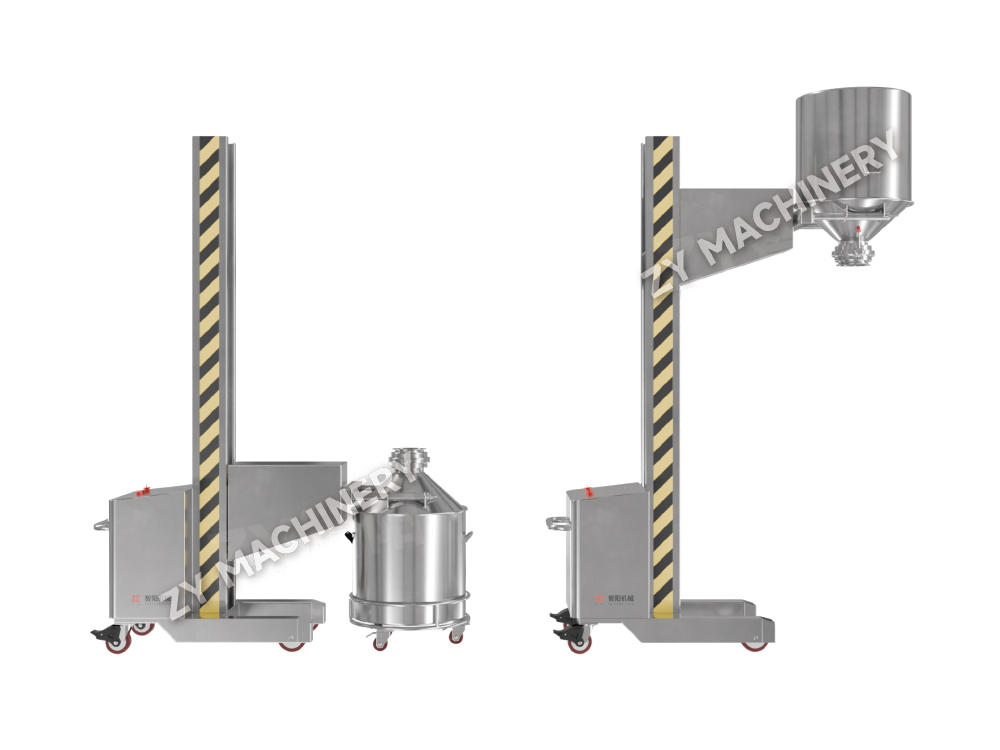
In small-batch lifting and conveying equipment formulation work, conveying is not only a transfer step. When powders with different particle sizes, densities, or flow properties move through lifting and horizontal conveying equipment, vibration, free fall, repeated acceleration, and long conveying distances can change the material distribution before it reaches the mixer. For formulations containing low-dose active ingredients or functional additives, this may affect the value of subsequent mixing trials.
Points that deserve attention during equipment selection
- Reduce unnecessary transfer height and avoid excessive drop distances at discharge points.
- Check whether the conveying route includes sharp transitions that may cause powder accumulation or selective discharge.
- For cohesive or electrostatic materials, consider contact surface finish, grounding, and cleanability together with conveying performance.
- Keep the receiving sequence stable when multiple ingredients are conveyed into a laboratory mixer.
For low-dose or composition-sensitive batches, the conveying route should be evaluated as part of the mixing process rather than as an independent handling step. At ZY, we consider material movement, charging order, and mixing verification together when developing workable process routes.
Matching Composite Conveying Layouts to Laboratory and Pilot Mixing Tasks
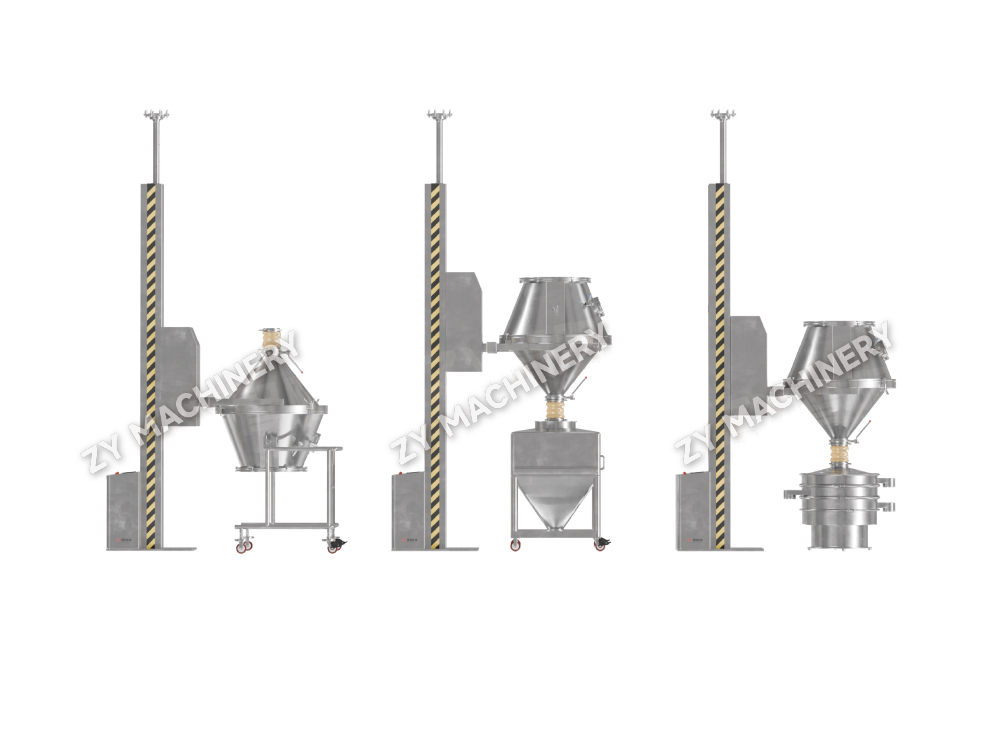
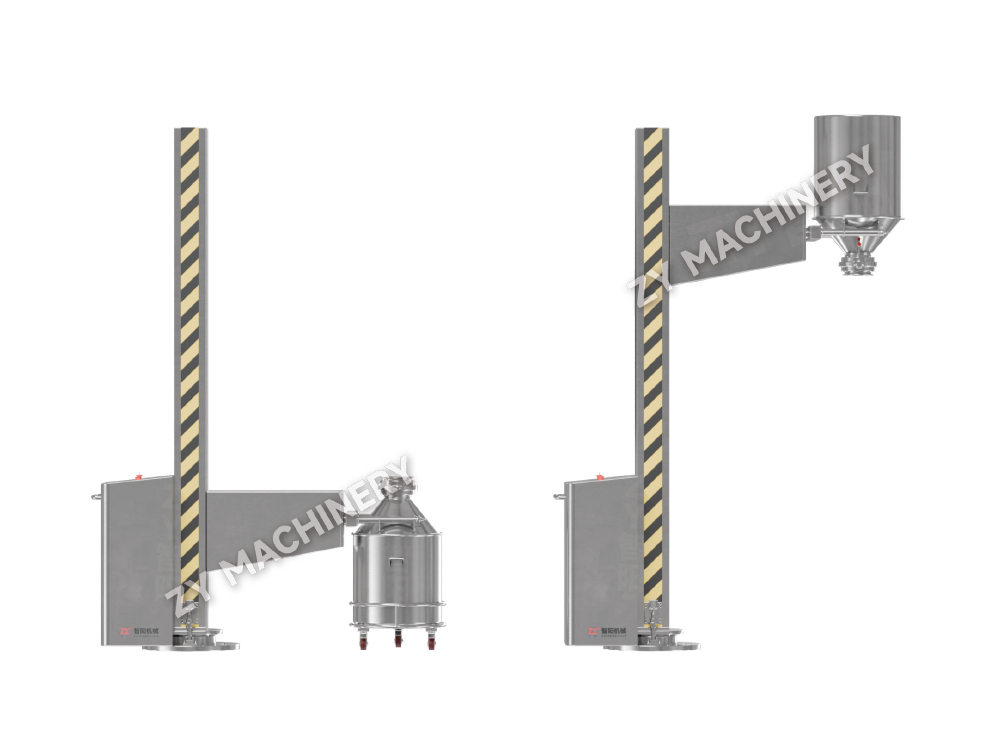
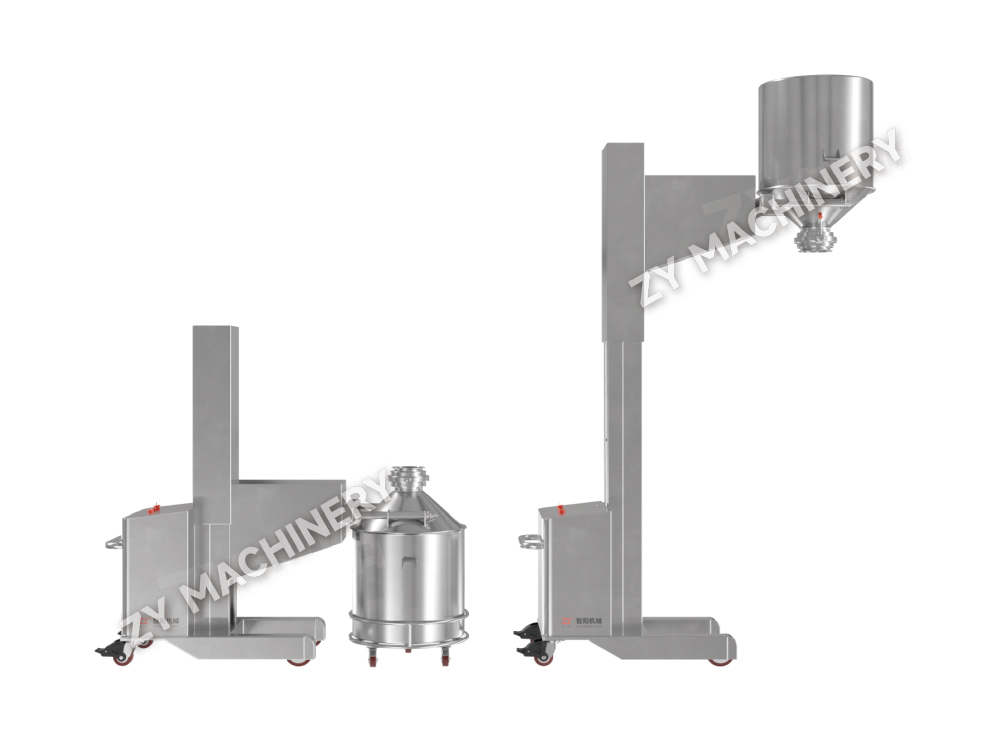
A combined lifting and horizontal conveying layout is especially useful where materials must pass between several workstations, such as weighing, pre-blending, wet mixing, temporary holding, and discharge collection. The practical question is not simply whether material can be moved upward, but whether the transfer arrangement supports repeatable batch preparation and convenient cleaning between formulation changes.
| Process Situation | Conveying Focus | Recommended Evaluation |
|---|---|---|
| Active ingredient and excipient pre-mixing | Controlled feeding and minimal segregation | Confirm charging sequence and post-transfer blend uniformity |
| Seasoning or meal replacement powder blending | Dust containment and fast product changeover | Inspect residue points and cleaning accessibility |
| Powder additive development | Stable delivery of difficult-flowing powders | Observe bridging, adhesion, and actual transfer yield |
| Pilot-scale process verification | Route scalability and continuous workstation connection | Record throughput, hold-up, and discharge consistency |
A compact laboratory arrangement may prioritize flexibility and fast cleaning, while a pilot line may require longer conveying distance, elevated discharge, and more stable connection between modules. The suitable layout is determined by material behavior, batch size, destination height, and the number of connected workstations. ZY develops configurations around these actual operating conditions.
Transfer Parameters That Should Be Verified Alongside Mixing Time and Speed
When laboratory mixing is used to confirm formulation compatibility and determine suitable mixing time or rotational speed, the transfer conditions should also be recorded. A powder blend may appear satisfactory under manual charging, yet behave differently after repeated lifting, conveying, and discharge. This is particularly relevant when future production will use integrated material transport rather than direct hand feeding.
Useful verification items for trial batches
| Verification Item | What It Indicates | Practical Use |
|---|---|---|
| Transfer yield before mixing | Material loss or retention in the equipment | Helps identify residue-sensitive formulations |
| Charging consistency | Repeatability of material entry into the mixer | Supports comparison between trial batches |
| Blend uniformity after transfer and mixing | Combined influence of conveying and mixer settings | Supports process parameter confirmation |
| Cleaning recovery and residual inspection | Potential carryover between products | Important for frequent formulation changes |
A valid laboratory result should reflect the material handling route expected in actual operation whenever possible. We at ZY use this principle to help customers turn mixing tests into more reliable scale-up references.
Design Details That Influence Cleaning, Containment, and Changeover Efficiency
For powder processing operations, lifting and conveying equipment often handles multiple materials or formulations within the same development area. Therefore, hygienic access, residual control, and dust management can be as important as transfer capacity. These considerations become more demanding when processing pharmaceutical powders, bio-related materials, nutraceutical blends, or additives that require controlled handling.
Constructive checks before purchase
- Identify whether product-contact areas can be accessed for inspection and cleaning without complicated dismantling.
- Confirm how discharge interfaces connect with laboratory mixers, wet mixing machines, bins, or downstream collection points.
- Evaluate enclosed transfer, sealing arrangements, and local dust-control needs for fine or easily dispersed powders.
- Review whether dead corners, flexible connections, or transition sections may retain material after discharge.
- Consider future changes in batch volume, destination height, and process modules before fixing the equipment layout.
A transport system that is easy to clean and correctly integrated can improve trial repeatability while reducing unnecessary interruption between products. For facilities handling frequent recipe changes, residue control and connection design should be assessed before maximum conveying speed. ZY supplies process-oriented equipment solutions intended to fit real material characteristics, site conditions, and production objectives.