English
 Español
 русский
 中文简体
中文简体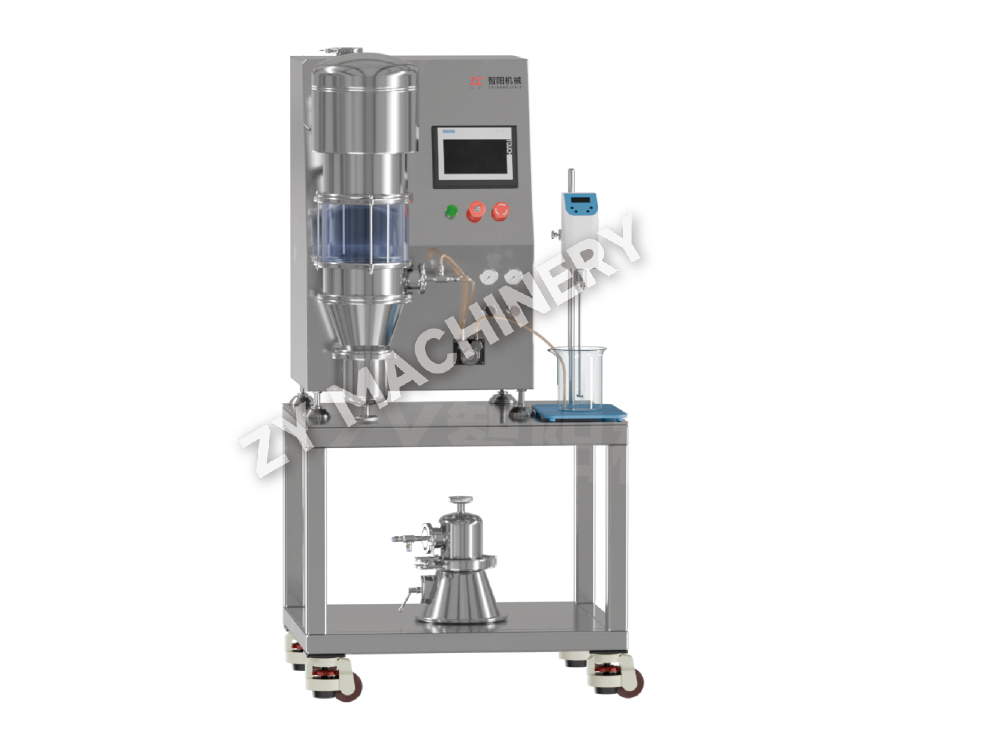





Industry Knowledge
Matching Coating Technology to Product Function
For potential buyers, the selection of laboratory coating equipment should begin with the required coating function rather than machine appearance or nominal capacity. Moisture protection, light shielding, taste masking, enteric performance, and modified release each place different demands on spray accuracy, drying behavior, material movement, and process repeatability.
| Coating Objective | Critical Laboratory Focus | Typical Material Form |
|---|---|---|
| Moisture protection | Continuous film formation and low defect rate | Tablets or granules |
| Taste masking | Surface coverage without excessive coating weight gain | Pellets or tablets |
| Enteric protection | Uniform functional membrane and controlled curing conditions | Tablets or multiparticulate pellets |
| Modified release | Highly repeatable layer thickness and release profile consistency | Pellets or granules |
A laboratory system is most valuable when it can reveal how formulation, spray rate, airflow, temperature, and material movement affect the final functional result. At ZY, we focus on developing equipment around the intended coating outcome and the behavior of the customer’s actual material.
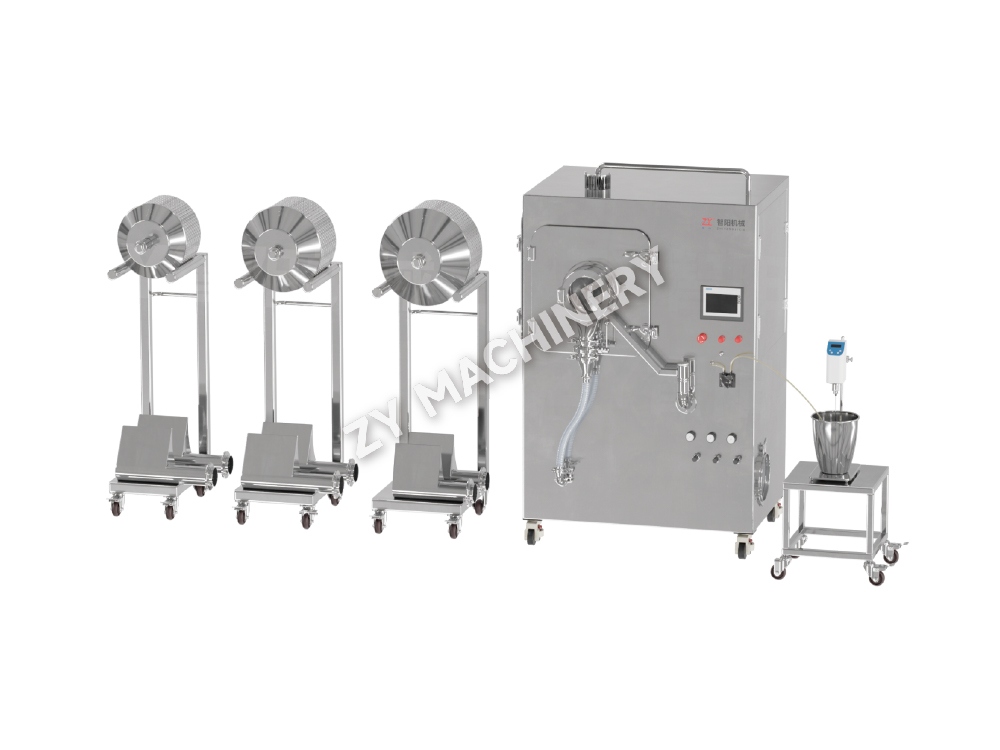
High-Efficiency Coating or Fluidized Bed Coating: Practical Selection Points
Laboratory high-efficiency coating machines and laboratory fluidized bed coating machines may both be used in formulation development, but they generally address different product structures and coating challenges. The correct choice reduces unnecessary trials and improves the value of scale-up data.
When pan-type high-efficiency coating is typically preferred
- Development of film-coated or enteric-coated tablets where tablet appearance and surface finish are important.
- Processes requiring observation of tablet rolling behavior, edge wear, sticking, twinning, or logo bridging.
- Projects intended for later transfer to production-scale tablet coating systems.
When fluidized bed coating is typically preferred
- Functional coating of pellets, granules, beads, or small particulate cores.
- Applications requiring efficient drying and controlled deposition on a large particle surface area.
- Modified-release development where coating uniformity among many small units directly influences dissolution consistency.
For candies, nuts, additive pellets, and oral solid dosage products, the material shape, friability, density, and target coating function should be evaluated together. The best laboratory machine is the one that reproduces the intended coating mechanism, not simply the one with the widest specification range. ZY supports this choice through material-oriented process assessment rather than one-size-fits-all equipment selection.
Process Parameters That Reveal Whether a Coating Formula Is Scalable
Laboratory coating trials should produce more than attractive sample batches. A useful development program records the operating window in which the product remains free-flowing, evenly coated, physically stable, and capable of meeting its functional objective. This information becomes the foundation for pilot and production transfer.
| Parameter or Observation | Why It Matters | Warning Sign |
|---|---|---|
| Spray rate | Controls wetting and coating deposition efficiency | Sticking, agglomeration, or rough surfaces |
| Inlet air temperature and airflow | Determines drying capacity and film formation conditions | Over-drying, spray drying, or insufficient film coalescence |
| Product temperature | Reflects the actual thermal condition experienced by the material | Unstable temperature during spraying |
| Weight gain and coating uniformity | Links coating quantity with protection or release performance | Large variation between samples |
| Discharge condition | Confirms mechanical integrity and handling suitability | Chipping, fines generation, adhesion, or color variation |
A stable process should tolerate reasonable adjustment without immediately creating defects. For controlled-release or enteric products, visual appearance alone is insufficient; coating trials should be linked with relevant dissolution or protection testing. We at ZY design laboratory coating solutions to help users build repeatable process data that can support later engineering decisions.
What Buyers Should Confirm Before Ordering Laboratory Coating Equipment
A technically suitable laboratory coating system must fit the material, development objective, cleaning requirements, and future production route. Before equipment selection is finalized, buyers should prepare representative information that allows the process route to be evaluated accurately.
Material and formulation information
- Core form, particle or tablet size range, bulk density, friability, and sensitivity to moisture or heat.
- Coating liquid type, solids content, solvent system, viscosity range, and anticipated coating weight gain.
- Required final function, such as masking, protection, enteric behavior, or sustained-release performance.
Equipment and implementation considerations
- Minimum and maximum practical batch size, especially when expensive active ingredients are involved.
- Ease of cleaning, product-contact material requirements, and cross-contamination control expectations.
- Availability of process monitoring points needed to compare batches and establish repeatable parameters.
- Compatibility with the intended pilot or production coating route to reduce scale-up uncertainty.
laboratory coating equipment should be purchased as a process-development tool, not only as a small-capacity machine. By considering material characteristics, target performance, batch scale, and site conditions together, buyers can obtain more useful trial results and avoid repeated equipment adjustment later. ZY provides standalone machines, modular systems, and process integration support from laboratory development through production implementation.