English
 Español
 русский
 中文简体
中文简体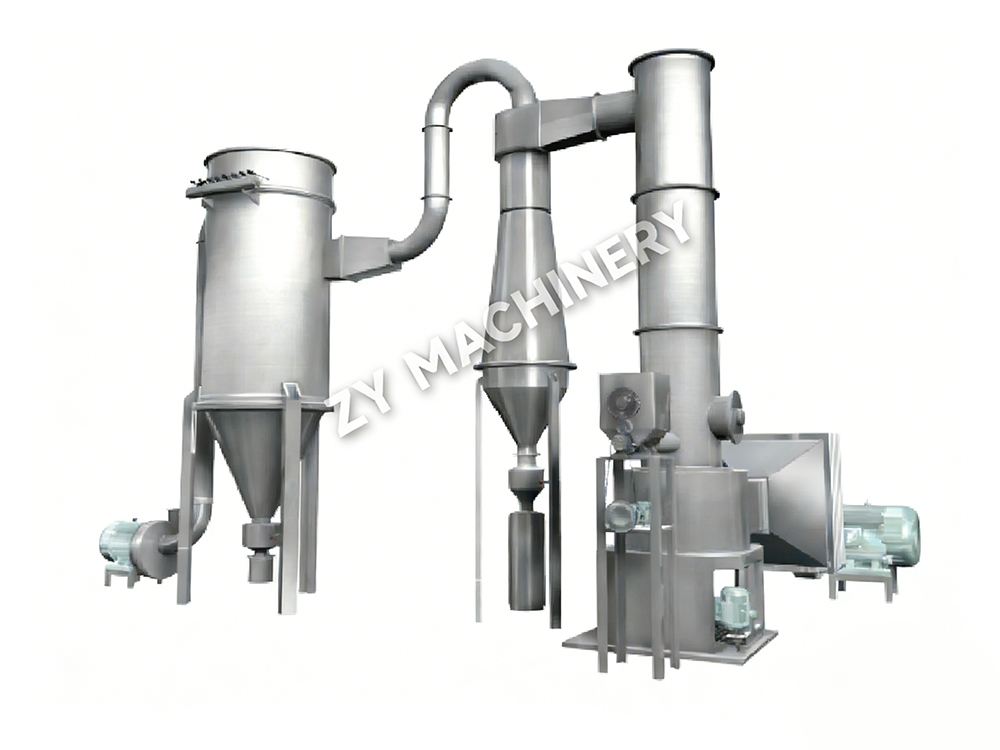

Industry Knowledge
Moisture Targets Should Be Set Around Flowability, Not Only Final Water Content
For sticky pastes, slurries, and filter cakes, the drying endpoint affects more than storage stability. Material that leaves the drying chamber with uneven residual moisture may soften during cooling, bridge in downstream hoppers, or form lumps during packaging. A practical target is therefore a moisture range that supports both product stability and reliable powder handling.
Useful checks during process confirmation
- Compare moisture at the dryer outlet with moisture after cooling, because warm powder may still show handling changes after discharge.
- Observe whether dried particles remain free-flowing after short-term storage in sealed bags or intermediate bins.
- Check whether the required moisture level causes excessive fine powder or reduced product recovery.
A stable flash drying process is achieved when moisture control, powder flow, and yield are verified together. At ZY, we configure drying conditions around the material behavior expected after discharge, rather than treating moisture as an isolated number.
Feed Conditioning Has a Direct Impact on Anti-Caking Performance
A flash dryer can rapidly remove moisture, but unstable feeding can still create deposits, oversize wet particles, or inconsistent residence time. For viscous materials, feed uniformity is closely related to viscosity, agglomerate size, pumpability, and the way the material enters the high-temperature air stream.
| Feed Condition | Possible Drying Effect | Process Attention Point |
|---|---|---|
| Highly variable viscosity | Irregular dispersion and uneven moisture removal | Maintain consistent upstream solids content and temperature |
| Large wet agglomerates | Wet cores or wall adhesion | Evaluate dispersion and breaking requirements before drying |
| Intermittent feed delivery | Outlet moisture fluctuation and temperature instability | Match feeding equipment with material rheology and capacity demand |
Before selecting Flash Dryers, buyers should provide representative material samples or realistic process data, including solids content, viscosity changes, stickiness, desired throughput, and acceptable outlet moisture. This information helps ZY define a more workable feed-and-drying route.
Thermal Exposure Must Be Evaluated Differently for Heat-Sensitive Powders
High inlet air temperature does not automatically mean excessive product temperature. In flash drying, rapid evaporation consumes substantial heat during the short contact period. However, heat-sensitive pharmaceutical, nutraceutical, biotechnology, veterinary, or additive products still require careful evaluation of outlet temperature, residence behavior, oxygen exposure where relevant, and the stability of key ingredients.
Data buyers should prepare for technical assessment
- Maximum acceptable product temperature or known degradation threshold.
- Sensitivity to oxidation, discoloration, aroma loss, potency reduction, or changes in dispersibility.
- Required particle characteristics after drying, such as fineness, bulk density, or redispersion behavior.
- Cleaning expectations and cross-contamination control requirements for regulated production.
For sensitive products, dryer selection should be based on verified product quality after drying, not inlet temperature alone. We at ZY use material characteristics and application targets to support lab, pilot, and production-scale process decisions.
A Practical Acceptance Test Should Include More Than Throughput
Capacity is important, but a Flash Dryer that reaches output targets while producing unstable moisture, frequent deposits, difficult cleaning, or excessive powder loss may create higher operating costs. For buyers processing sticky materials, acceptance criteria should reflect day-to-day production risks as well as nominal performance.
| Acceptance Item | What to Verify | Why It Matters |
|---|---|---|
| Moisture consistency | Repeated sampling under stable production conditions | Supports downstream flow and product quality consistency |
| Wall adhesion and caking | Inspection after continuous operation | Indicates whether sticky material can be handled reliably |
| Product recovery | Collected dry product compared with feed solids | Reveals losses from fines, deposits, or collection limitations |
| Cleaning practicality | Accessibility, residue removal, and cleaning time | Reduces downtime and supports hygiene control |
When a project requires integration with feeding, powder collection, conveying, or subsequent processing equipment, ZY can develop a coordinated process route instead of supplying an isolated machine. The most useful purchasing decision is based on repeatable production performance under real material conditions.