English
 Español
 русский
 中文简体
中文简体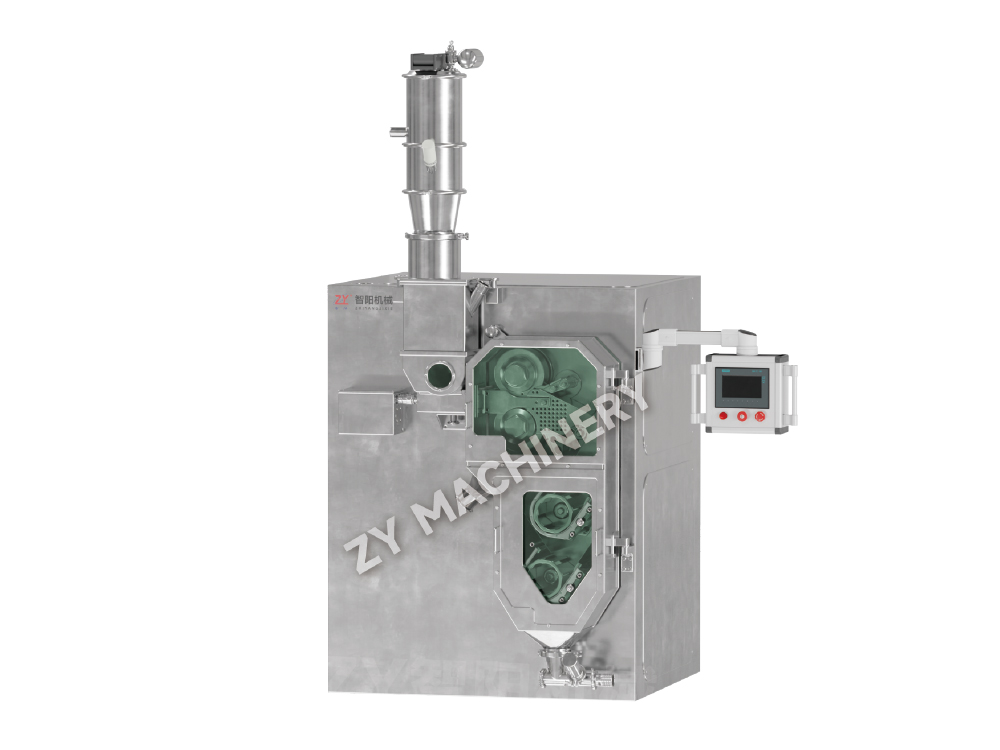




Industry Knowledge
How Material Properties Influence Dry Granulation Results
Successful dry granulation depends less on a single pressure setting than on how the powder responds to compression, release, crushing, and screening. For buyers evaluating equipment, material behavior should be reviewed before selecting roller force, feeding structure, or granule sizing configuration.
Key material factors to evaluate during trials
- Compressibility: Materials with poor compactability may require higher pressure, but excessive pressure can produce overly hard ribbons and excessive fines after milling.
- Moisture sensitivity: Dry granulation avoids liquid addition, making it suitable for moisture-sensitive formulations, but overly dry powders may show weak bonding or electrostatic handling problems.
- Particle size distribution: Very fine powders may compact well but feed poorly, while coarse or highly irregular particles may cause unstable ribbon density.
- Flowability: Poor flow at the inlet can lead to inconsistent feeding, fluctuating compaction, and uneven granule quality.
A practical test should compare ribbon appearance, granule yield, fines proportion, flow behavior, and downstream tablet or capsule performance. A stable process window is usually more valuable than a single attractive sample result.
At ZY, we develop process routes around actual powder characteristics and target capacity rather than relying on fixed machine assumptions.
What Buyers Should Check in Roller Compaction and Granule Sizing
The quality of dry granules is controlled by a connected sequence: controlled feeding, consistent compaction, ribbon handling, crushing, and final sizing. When one step is unstable, increasing pressure alone rarely solves the underlying problem.
| Process Point | What to Observe | Possible Adjustment Direction |
|---|---|---|
| Powder Feeding | Irregular feed rate or air entrainment | Review feeder design, speed, and deaeration behavior |
| Ribbon Formation | Cracks, lamination, or density variation | Optimize pressure, roller gap, and feeding consistency |
| Crushing | Too many fines or oversized fragments | Adjust milling intensity and screen specification |
| Finished Granules | Poor flow, segregation risk, or unstable bulk density | Reconfirm particle size target and process balance |
For pharmaceutical and nutraceutical production, granules should not only meet a sieve range; they should also support stable filling, compression, or downstream blending. Granule consistency must be judged by downstream usability, not appearance alone.
ZY can integrate compaction and sizing considerations into a complete powder-processing solution, from trial evaluation to production implementation.
Why Pre-Blending Quality Matters Before Dry Granulation
Dry granulator cannot correct a poorly distributed formulation before compaction. When active ingredients, excipients, flavor components, nutritional powders, or additives are not uniformly blended, the granulator may produce physically acceptable granules that still fail content uniformity or functional consistency requirements.
Useful checks during small-batch process development
- Confirm whether low-dose ingredients distribute evenly within the selected mixing time.
- Compare rotational speed settings to prevent insufficient mixing or unnecessary particle damage.
- Observe whether differences in bulk density or particle size create segregation before feeding into the granulator.
- Verify that the chosen formulation remains compatible after compaction and granule sizing.
Laboratory-scale blending equipment, including bin-type laboratory mixers and wet mixing laboratory machines used during formulation work, can support parameter confirmation before a dry granulation route is finalized. For a dry process, the pre-blending stage is especially important because no binder solution is later added to redistribute the formulation.
Uniform input material is a prerequisite for repeatable granulation output. At ZY, we consider mixing validation and granulation evaluation as connected process decisions rather than isolated equipment selections.
Planning the Move from Trial Batches to Production Capacity
A formulation that performs well during laboratory trials may behave differently at production scale because feeding continuity, material residence time, heat generation, ribbon width, and granule recycling conditions change with capacity. Buyers should therefore assess scale-up requirements before confirming a machine model or production-line layout.
Information worth preparing before equipment selection
| Information Category | Examples of Useful Data | Why It Matters |
|---|---|---|
| Material Profile | Flowability, moisture level, density, particle size | Supports feeder and compaction configuration |
| Granule Target | Desired size range, fines limit, bulk density | Determines crushing and screening requirements |
| Capacity Requirement | Batch size, hourly output, operating schedule | Helps define equipment scale and line arrangement |
| Site Conditions | Room height, cleaning approach, containment needs | Prevents installation and compliance difficulties |
A sound scale-up plan should preserve critical material behavior while improving production efficiency. This may require staged testing from laboratory evaluation to pilot verification and then full-scale production confirmation.
With experience in standalone machines, modular systems, and complete production lines, ZY focuses on providing workable engineering implementation plans for dry granulation applications in pharmaceutical, biotechnology, nutraceutical, veterinary, additive, and related powder-processing fields.