English
 Español
 русский
 中文简体
中文简体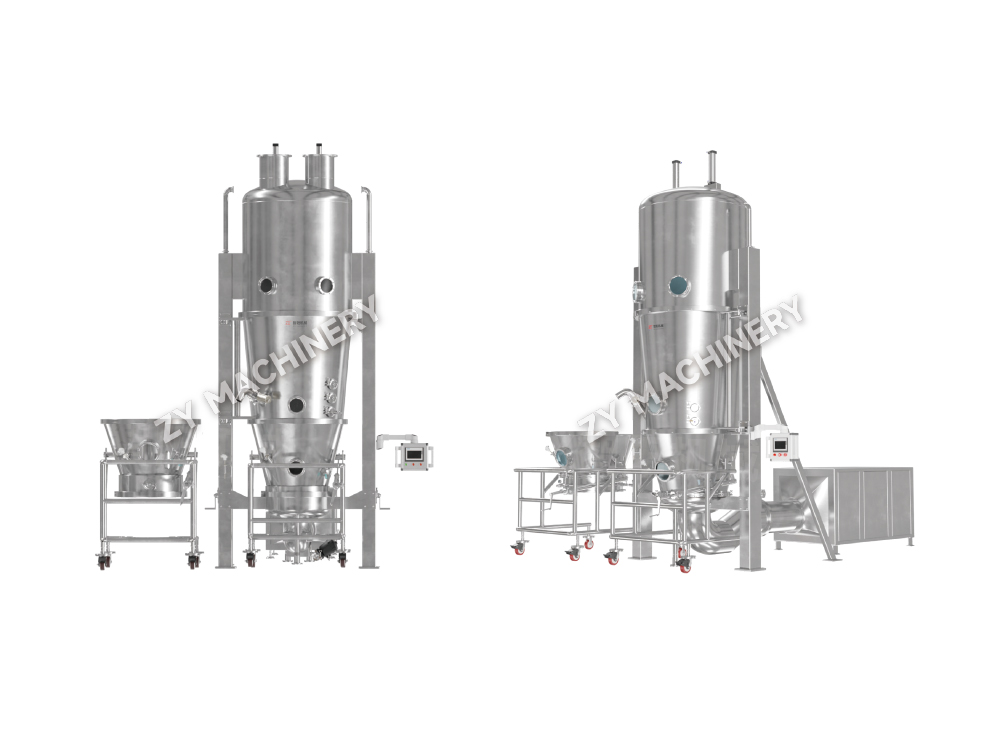

Industry Knowledge
How to Judge Whether a Fluidized Bed Granulation Process Is Stable
For buyers, stable granulation is not only reflected by whether granules can be produced. A practical evaluation should focus on whether particle growth, moisture removal, and final discharge quality remain controllable across repeated batches.
Key observations during process trials
- Fluidization should remain even, without obvious dead zones, channeling, or excessive material adhesion to the chamber wall.
- Binder spraying should produce controlled agglomeration instead of rapid overwetting, large lumps, or nozzle-area buildup.
- Product temperature and outlet air behavior should indicate a repeatable transition from wet granulation to drying.
- Discharged granules should show acceptable flowability, size distribution, moisture level, and low batch-to-batch variation.
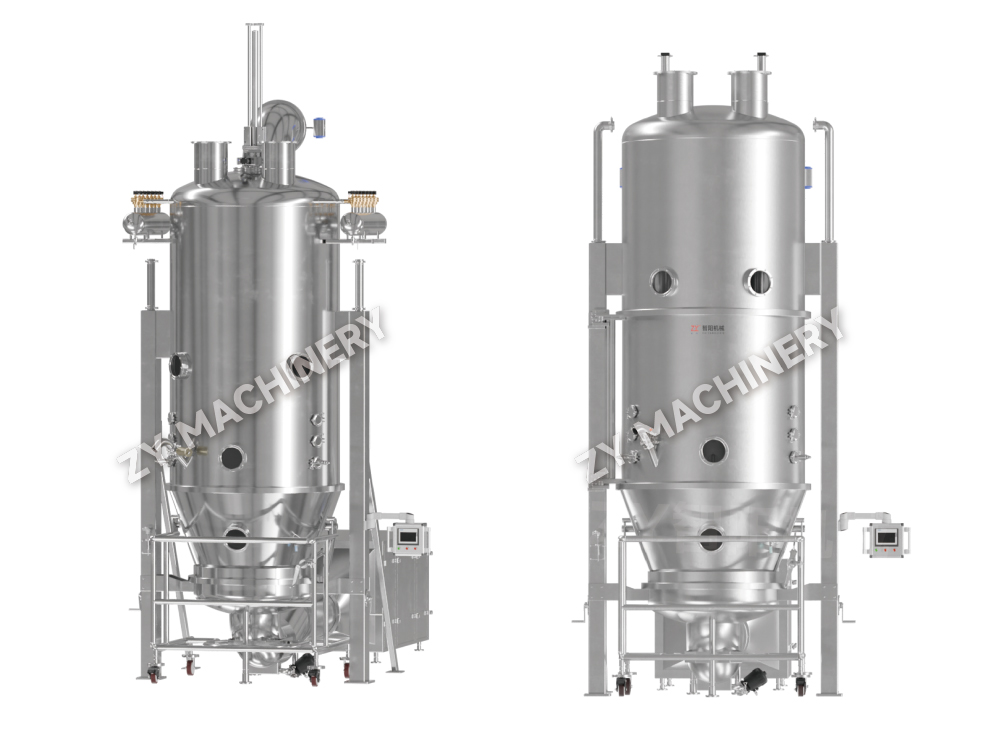
A suitable fluidized bed granulator should make the process window easier to identify and reproduce, rather than requiring constant operator correction. At ZY, we evaluate equipment selection around material behavior, target capacity, and expected granule quality.
Binder Spraying Parameters That Directly Influence Granule Quality
In fluidized bed granulation, binder selection alone does not determine the result. Spray rate, atomization quality, droplet size, nozzle position, and inlet air conditions work together. Small changes in these settings can significantly affect agglomeration behavior and drying efficiency.
| Parameter | When Too Low | When Too High | Buyer Evaluation Focus |
|---|---|---|---|
| Spray rate | Weak agglomeration and excessive fines | Overwetting, sticking, large agglomerates | Stable adjustment range under intended batch load |
| Atomization pressure | Large droplets and uneven wetting | Fine droplets may dry before effective binding | Uniform spray pattern and accessible nozzle cleaning |
| Inlet air temperature | Slow drying and wet mass buildup | Surface drying before sufficient granule growth | Controllable thermal conditions for sensitive formulas |
| Airflow volume | Poor fluidization and non-uniform processing | Attrition, fines generation, unstable spraying contact | Consistent fluidization across minimum and maximum loads |
Before purchase, it is constructive to request trials using representative materials and binder systems. The objective is to confirm an adjustable, repeatable parameter window rather than a single successful batch. ZY develops process routes with this production-oriented verification in mind.
Why Upstream Mixing Verification Matters Before Granulation
Granulation performance can be affected before powder enters the fluidized bed. When active ingredients, excipients, flavors, nutrients, or powder additives are not evenly distributed during pre-mixing, later spraying and drying cannot fully correct the original composition imbalance.
Small-batch verification can reduce scale-up uncertainty
Laboratory mixing tests are useful for evaluating formulation compatibility and establishing practical values for mixing time and rotational speed. Bin-type laboratory mixers and wet mixing laboratory machines can help confirm whether the material system is suitable for subsequent granulation development.
| Verification Item | Practical Purpose | Value for Granulation Planning |
|---|---|---|
| Mixing uniformity | Confirm distribution of key powder components | Reduces quality variation transferred into granules |
| Mixing time | Avoid insufficient blending or unnecessary processing | Supports efficient batch preparation |
| Rotational speed | Assess material movement and segregation tendency | Helps establish reliable feeding material conditions |
For pharmaceutical, food, nutraceutical, veterinary, and additive applications, good granulation begins with a well-understood premix. We at ZY can combine mixing verification with downstream equipment planning when a complete process route is required.
Equipment Configuration Questions Buyers Should Confirm Before Ordering
A fluidized bed granulator should be selected around actual materials and production requirements, not nominal capacity alone. Differences in bulk density, moisture sensitivity, binder viscosity, cleaning expectations, and workshop layout can influence configuration decisions.
Information worth preparing for technical discussion
- Target batch size, expected daily output, and whether laboratory, pilot, or full-production operation is required.
- Powder characteristics such as flowability, bulk density, hygroscopicity, heat sensitivity, and tendency to adhere.
- Binder type, concentration, viscosity, solvent system, and intended spraying method.
- Required final granule properties, including particle-size range, residual moisture, flowability, and downstream compression or filling needs.
- Site constraints, cleaning approach, material transfer method, utility conditions, and integration with upstream or downstream equipment.
Supplying complete material and process data early helps avoid oversized equipment, restricted operating ranges, and unnecessary modification after installation.
ZY provides standalone machines, modular systems, and production-line integration based on process needs. Our focus is to turn formulation goals and site conditions into an implementable equipment plan with a practical balance of consistency, efficiency, reliability, and cost.