English
 Español
 русский
 中文简体
中文简体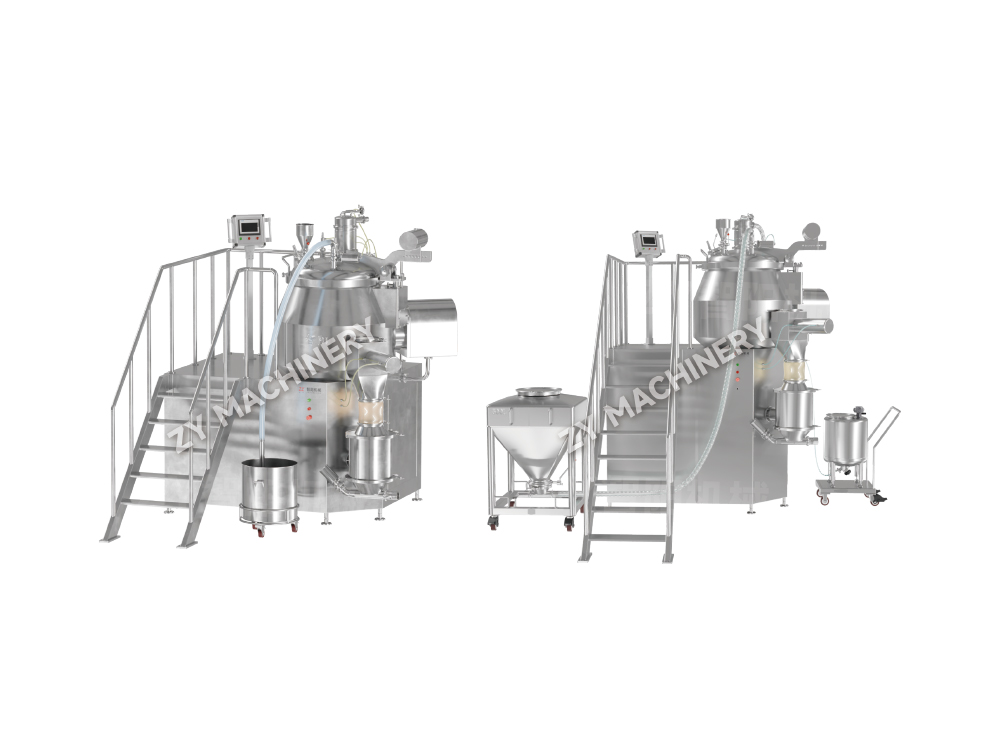

Industry Knowledge
How to Judge the Granulation End Point in Development Trials
In wet granulator, the most important trial result is not simply whether granules can be produced, but whether the wet mass reaches a repeatable and transferable end point. A suitable end point supports stable granule size distribution, manageable drying behavior, and consistent downstream compression or filling performance.
Practical observations during a laboratory batch
- Dry powder remains visible after binder addition: binder distribution or wetting time may be insufficient.
- Wet mass forms weak, dusty granules: liquid level, kneading intensity, or mixing time may be too low.
- Material sticks heavily to the bowl or blades: the formulation may be over-wetted or mechanically over-processed.
- Granules are cohesive but break apart predictably during screening: this is often a useful development target.
The most useful laboratory result is a documented processing window, not a single successful batch. For each formulation, buyers should expect records of binder quantity, addition rate, mixing time, blade speed, wet mass appearance, and screened granule condition.
At ZY, we use small-batch trials to help establish practical operating ranges before equipment configuration is finalized.
Binder Addition Strategy Has a Direct Effect on Batch Consistency
The same formulation can produce very different granules when the binder is added too quickly, unevenly, or at an unsuitable concentration. During equipment selection, it is constructive to evaluate how the machine supports controlled binder contact with the powder bed rather than focusing only on nominal capacity.
| Process Condition | Likely Batch Effect | Development Check |
|---|---|---|
| Binder added too rapidly | Local overwetting and large agglomerates | Compare staged addition with continuous addition |
| Binder concentration too low | Weak granules and higher fines | Evaluate granule integrity after drying |
| Binder concentration too high | Sticky wet mass and longer drying demand | Check bowl adhesion and moisture removal time |
| Poor powder pre-blending | Uneven wetting and content variation risk | Confirm mixing uniformity before binder addition |
Binder addition should be treated as a controlled process parameter, not merely a material input. This is especially important for active ingredient and excipient pre-mixes where distribution uniformity is critical.
Drying Capacity Should Be Matched to the Wet Granulation Route
A wet granulator cannot be assessed independently from the drying step. Binder quantity, wet granule density, particle size, and batch loading all influence the amount of moisture that must be removed and the time required to achieve a stable final product.
Information buyers should define before line configuration
- Expected wet batch weight and target throughput per shift.
- Initial moisture range after granulation and required residual moisture after drying.
- Whether the material is sensitive to temperature, prolonged exposure, or excessive attrition.
- Required transfer method between granulation, drying, sizing, and final blending stages.
A machine with sufficient mixing capacity may still restrict production output when the paired dryer is undersized or when wet material handling creates long waiting periods. Production balance depends on the complete process route rather than the granulator capacity alone.
ZY can align granulation, drying, and downstream handling around the material properties and intended operating rhythm, reducing avoidable bottlenecks during implementation.
Using Small-Batch Equipment to Reduce Scale-Up Risk
Laboratory wet mixing and granulation equipment is valuable when it is used to answer specific production questions: whether a formulation blends uniformly, whether the binder route is workable, and whether mixing time and rotational speed provide an acceptable granule structure.
| Trial Objective | Useful Equipment Type | Decision Supported |
|---|---|---|
| Verify dry powder uniformity | Bin-type laboratory mixer | Pre-blending suitability and mixing time |
| Evaluate binder compatibility | Wet mixing laboratory machine | Binder route and wet mass behavior |
| Prepare for pilot or production scale | Laboratory granulation and related equipment | Initial parameter window and process integration requirements |
For pharmaceutical powders, food blends, and additive formulations, trial work should capture changes in flowability, adhesion, granule strength, drying response, and cleaning difficulty. These observations can prevent unsuitable equipment selection and repeated reformulation during scale-up.
With process-driven engineering, ZY develops solutions around capacity targets, site conditions, and material characteristics, from laboratory verification to integrated production lines.