 English
 Español
 русский
 中文简体
FL-B Fluid-bed Granulation & Drying Machine (One-Step Granulator)
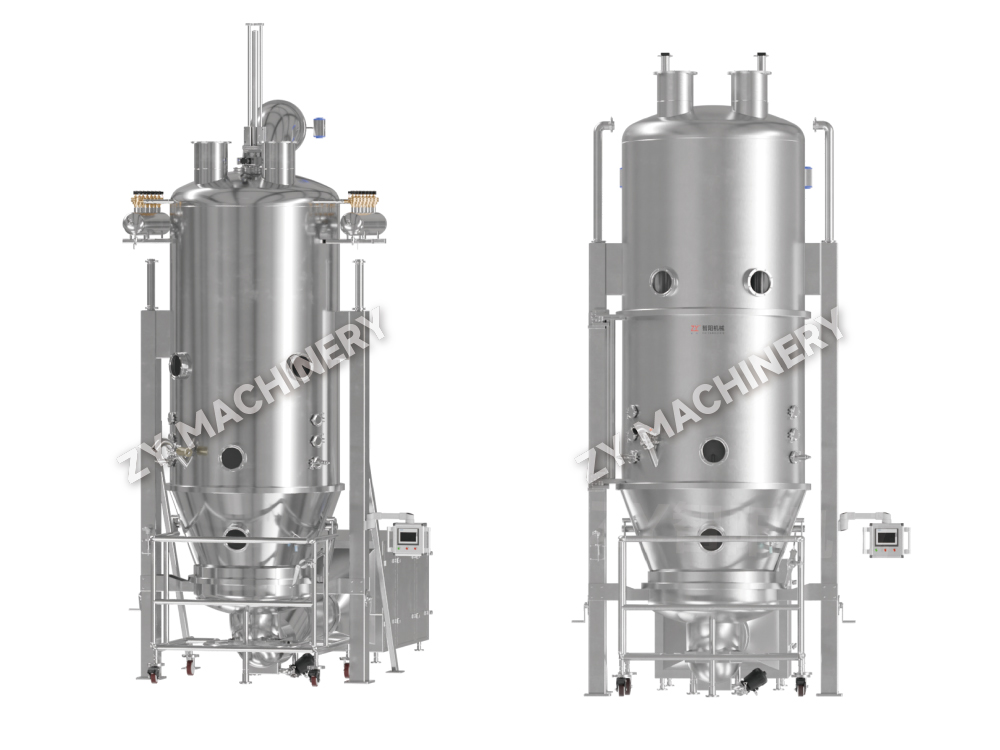
The FL-B Fluidized Bed Granulation & Drying Machine is designed for pow.....

Content
Some powders simply refuse to cooperate. They bridge in the hopper, they flood when you try to fill a die, and after an hour of tumbling they quietly separate again. When the active ingredient also happens to be sensitive to water or heat, wet granulation stops being the obvious answer, and the formulation team starts asking about a dry route. Roller compaction is usually where that conversation leads.
We have been building powder handling and oral solid dosage equipment since 2010, and dry granulation projects are among the ones we enjoy most, because the powder always has an opinion. What follows is a practical view of pharmaceutical roller compaction: how it works, which parameters actually move the needle, and where the process tends to go wrong.
Roller compaction is dry granulation. Powder is drawn into the gap between two counter-rotating rolls, densified under pressure, and leaves the machine as a compacted sheet, usually called a ribbon or flake. That ribbon is then milled into granules sized for the next step. No liquid is added and nothing is evaporated, so the formulation stays exactly as written and a moisture-sensitive or heat-sensitive active never meets water or a hot air stream.
Three things change in the material. Bulk density rises, often several fold, which shrinks the volume you have to handle and makes the blend far easier to fill consistently. Flow improves, because dense granules roll past each other instead of locking together. And segregation slows down, since the ingredients are now locked inside the same particle rather than sitting next to each other as separate powders of different size and density.
There is a price, and it is worth stating plainly. Compaction consumes part of the material's ability to deform later. A ribbon pressed too hard produces granules that will not bond again in the tablet press, and tablet hardness quietly falls even though everything else looks fine. Choosing the right pressure is always a compromise between granule strength and remaining compressibility.
Powder reaches the compaction zone through a feed screw, sometimes vertical, sometimes horizontal, and often fed by vacuum transfer or directly from a bin. The screw does more than transport: it pre-compresses and de-aerates the powder so the rolls see a consistent bulk density. In our experience an unstable feed, not an unstable hydraulic system, is the most common root cause of an inconsistent ribbon.
One roll is fixed and the other sits on a hydraulic ram, forming the nip. Pressure, gap and roll speed are set from the control panel and logged. Side seals or cheek plates stop powder from squeezing out laterally, which is what keeps the ribbon edges from turning into a loose, dusty fringe. Roll surface matters too: smooth rolls are easier to clean and suit abrasive or sticky products, while knurled or rimmed rolls grip fine, airy powders and hold the material in the compaction zone long enough to densify.
The ribbon is broken down in a mill, either integrated into the compactor or standing beside it. Screen size and rotor speed decide the granule size distribution and how much fines you generate. An integrated mill keeps the transfer short and enclosed, which is a real advantage with potent compounds where every open transfer is a containment problem.
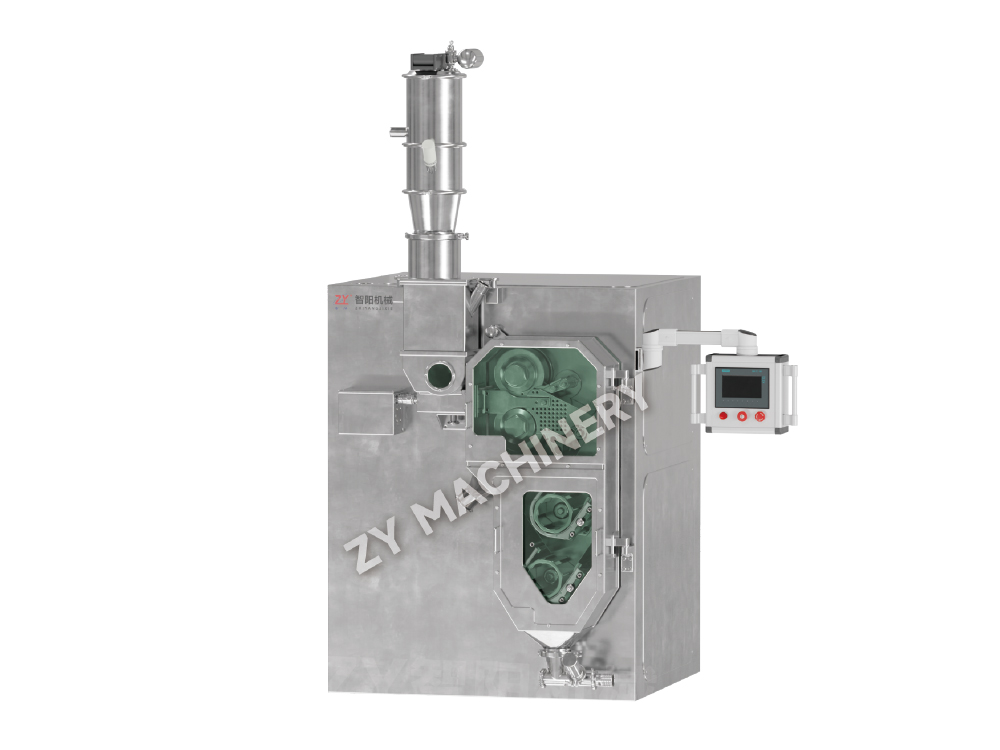 GK Roller Compactor Dry Granulation SystemA dry granulation system for moisture- or heat-sensitive powders, with models from lab to production and options for integrated milling.View Product →
The variables below are the ones we adjust first during a trial run. None of them can be read off a catalogue; the useful window has to be found on the actual formulation.
| Parameter | Main effect | Practical note |
|---|---|---|
| Compaction force | Ribbon density, granule strength | Raise until fines drop, then back off before compressibility suffers |
| Roll speed | Dwell time in the nip | Faster rolls mean less densification at the same force |
| Gap width | Ribbon thickness and throughput | Thin ribbons densify more evenly; thick ones can band |
| Feed screw speed | Material supply to the nip | Keep the ratio to roll speed stable, not the absolute value |
| Roll surface design | Grip, slip, edge integrity | Match to particle size and stickiness of the blend |
| Mill screen and rotor speed | Granule size distribution, fines | Set after the ribbon is right, not before |
Roller compaction earns its place when the formulation cannot tolerate water or heat, when the drug load is high, when a controlled-release matrix must avoid granulation liquid, or when a continuous line is being designed and a dry, solvent-free step is welcome. It also suits high-potency products, because a compacted ribbon generates far less airborne dust than a dry blend.
It is a poorer fit for very plastic materials that harden irreversibly under pressure, for products that need true spherical pellets, where extrusion and spheronization is the better route, and for blends containing low-melting or waxy components that smear on the rolls. Very elastic, brittle powders may also refuse to form a coherent ribbon at any sensible pressure.
Most of these are solved by changing one variable at a time and sampling the ribbon, not the granules. Once the ribbon is consistent, the mill is easy to tune.
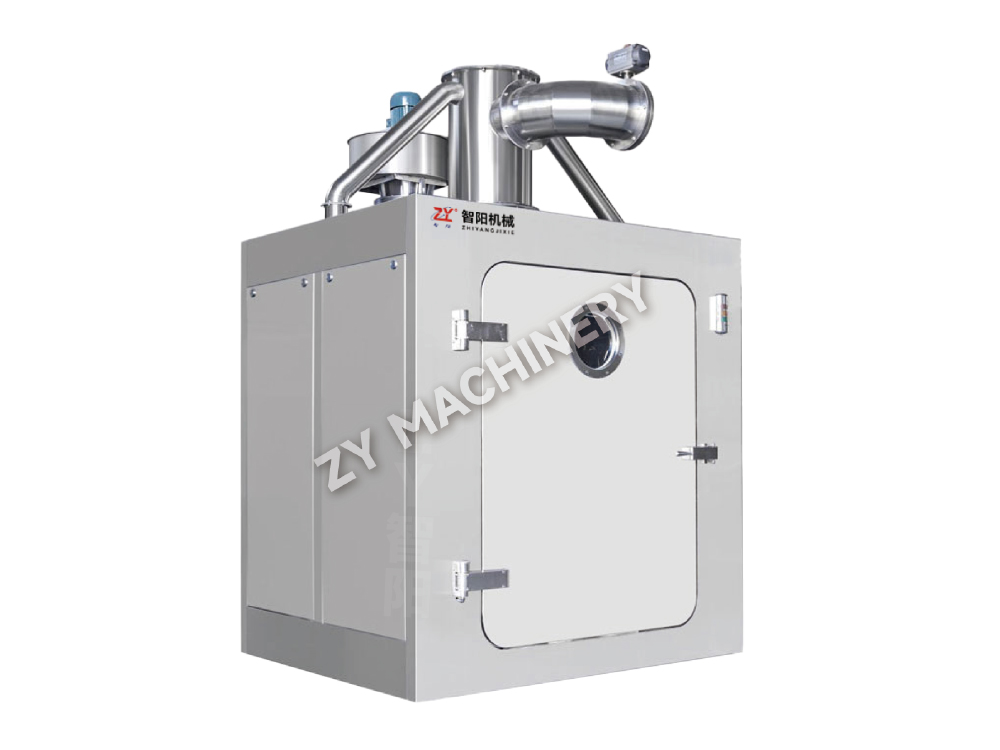
 GZL Rapid Milling and Granulating MachineCombines milling and sizing for dry or wet granules, with adjustable rotor-to-screen clearance for particle-size control and low-dust processing.View Product →
Scaling up a roller compaction process is not a matter of keeping the pressure number identical. Roll diameter changes the nip geometry, so the same gauge pressure gives a different result on a laboratory unit and on a production machine. The robust anchor is the ribbon itself: measure solid fraction or density and reproduce that, then adjust speed and gap to keep throughput where you need it. Our formulation development equipment guide walks through the same logic for the surrounding unit operations.
It also helps to keep the rest of the chain consistent. If the feed system changes between scales, the density entering the nip changes, and the comparison falls apart. Running the lab unit with the same transfer and discharge arrangement, even at small volume, saves a surprising amount of time later.
Screening after milling is easy to overlook and easy to regret. Oversize granules and compacted flakes that survived the mill should be removed before blending, and a compact vibrating screen does that job without adding much footprint.
 ZS Centrifugal Vibrating Sieve for Continuous ScreeningA continuous in-line screener for grading coarse and fine particles, helping remove oversize granules and compacted flakes before blending.View Product →
Roller compaction rarely fails because of the machine alone. It fails when feed, force, ribbon and milling are tuned separately, or when a process validated on a small unit is copied onto a large one by numbers instead of by ribbon density. If you are working through a difficult powder right now, tell us what it does in the hopper and what your tablet press complains about; that conversation is usually where the useful answers start. You can reach our process team here, and we will look at your material before we look at our catalogue.
Want to stay up to date?
Contact us via the email address below.
Don't worry about spam. We hate it too!
Mobile Client

Video Account
Phone:+86-15161130178
Tel:+86-519-88674267
Email:czzy188@163.com
Phone:+86-15161132798
Email:zy@zy-drying.com

WeChat ID

Copyright 2026 Changzhou Zhiyang Machinery Equipment Co., Ltd. All Rights Reserved  Oral Solid Dosage Equipment Manufacturer