 English
 Español
 русский
 中文简体
AH Airflow Mixer
The AH Airflow Mixer is specifically designed to meet the batch mixing requ.....

Content
Oral solid dosage manufacturing is one of those fields where the finished tablet or capsule looks beautifully simple while the route that produced it is anything but. Behind every dose sits a chain of unit operations — dispensing, blending, granulating, drying, sizing, compression, coating, and the transfers in between — and each link can quietly decide whether a batch meets specification or ends up as a deviation report.
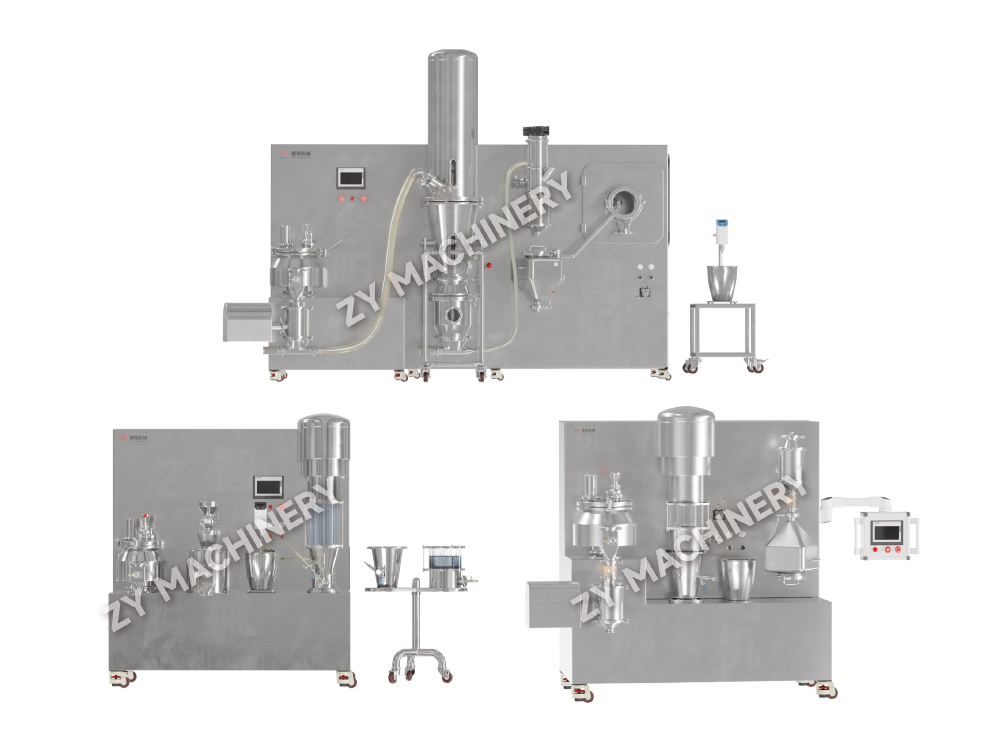
ZY Machinery has been building equipment and process routes for this world since 2010. We design and manufacture powder handling and oral solid dosage equipment for pharmaceutical, bio-pharmaceutical, biotechnology, nutraceutical, veterinary, and additives manufacturers, covering single machines, modular systems, and complete lines from laboratory and pilot scale through to full production. Material characteristics, capacity targets, and site conditions come first; the machine follows. Here is how an OSD line actually comes together.
Three requirements shape almost every technical decision in an OSD plant.
These themes explain why solid dosage production relies on so many different machines instead of a few large ones: each unit operation exists to control a specific risk.
Most oral solid dosage processes for tablets, granules, and capsules follow the same general sequence, although the order and the specific equipment change with the formulation.
| Unit Operation | Role in the Process | Typical Equipment |
|---|---|---|
| Dispensing and feeding | Accurate weighing and dust-free introduction of API and excipients | Weighing and feeding stations, dust-free feeding stations |
| Blending | Homogeneous distribution of a small active fraction through the bulk | Bin mixers, V-type, double-cone, and multi-directional mixers |
| Granulation | Improved flow, compressibility, and uniformity of the blend | High-shear mixers, fluid bed granulators, roller compactors |
| Drying | Moisture reduction to a defined and repeatable range | Fluid bed dryers, vacuum dryers, hot air circulating ovens |
| Milling and sizing | Narrowing the particle size distribution after drying | Milling and granulating machines, oscillating granulators, vibrating sieves |
| Coating | Functional, protective, or aesthetic film application | Perforated pan film coating machines, fluid bed coaters |
| Transfer and cleaning | Contained material movement and fast, verifiable batch changeover | Bin lifting and feeding machines, vacuum feeders, bin washing machines, mobile CIP stations |
Not every product visits every stage. A directly compressible formulation may skip granulation and drying entirely, while a moisture-sensitive or high-potency compound may need vacuum drying and fully contained transfer. The line is built around the molecule, not the other way around.
Blending looks like the simplest step in the whole line and is often treated that way, which is precisely why it causes so many problems. Two questions matter most: how well the mixer distributes a small amount of active through a large volume of excipient, and how gently it treats the blend so that segregation does not begin the moment mixing stops.
Bin mixers are popular for good reasons. The blend stays in the same container from mixing through transport to the compression machine, which removes a transfer step and, with it, a segregation risk. Tumble mixers such as V-type, double-cone, and multi-directional designs suit free-flowing materials, while high-shear and airflow mixers handle cohesive powders and larger batch volumes.
Feeding matters just as much upstream. Weighing and feeding stations and dust-free feeding stations determine how accurately the formula is actually assembled before a single blade turns. For a closer look at how these machines behave, see our overview of bin mixer options.
Granulation exists to fix the weaknesses of a powder blend: poor flow, dust, segregation, and uneven compressibility. Wet granulation builds granules with a binder liquid, typically in a high-shear mixer where impeller and chopper action control both the wet mass and the final granule size. Dry granulation takes the opposite path, compacting powder between rollers and then milling the ribbons into granules, which is a useful route when the API cannot tolerate moisture or heat.
The choice between them is a formulation decision with equipment consequences. Batch size, binder system, and the target granule size distribution all point toward one route or the other, and that decision is far cheaper to make before the line is ordered than after it is installed.
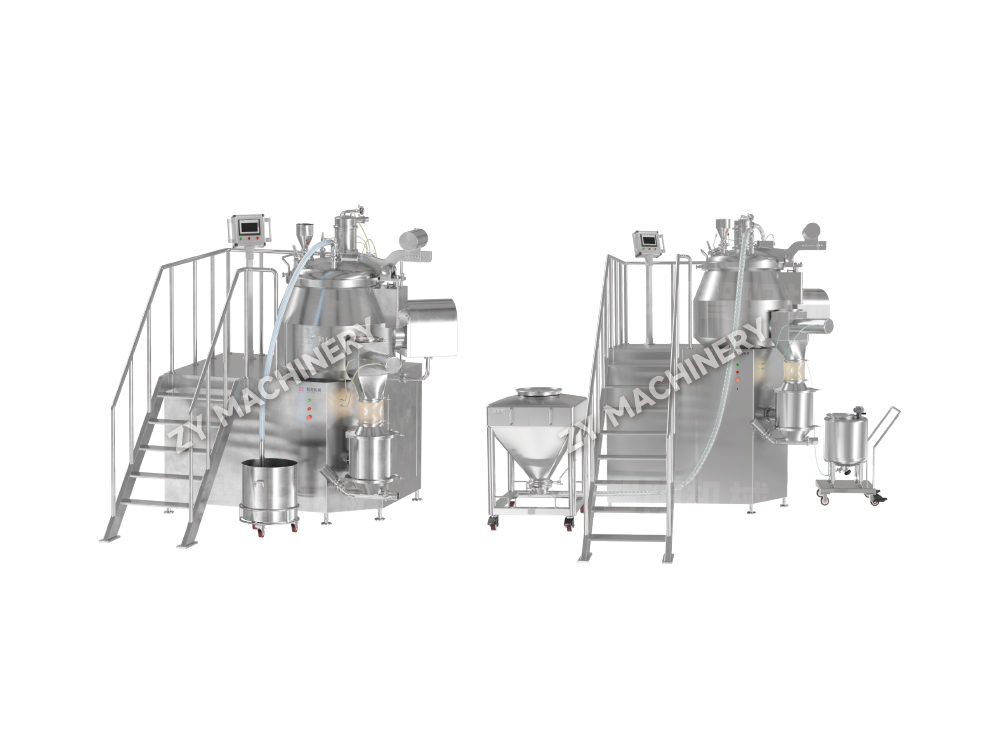 GHL High Speed Mixing GranulatorThe GHL High-Speed Mixing and Granulation Machine is a highly efficient system designed to blend multiple powdered materials and convert them into uniform granules in ...View Product →
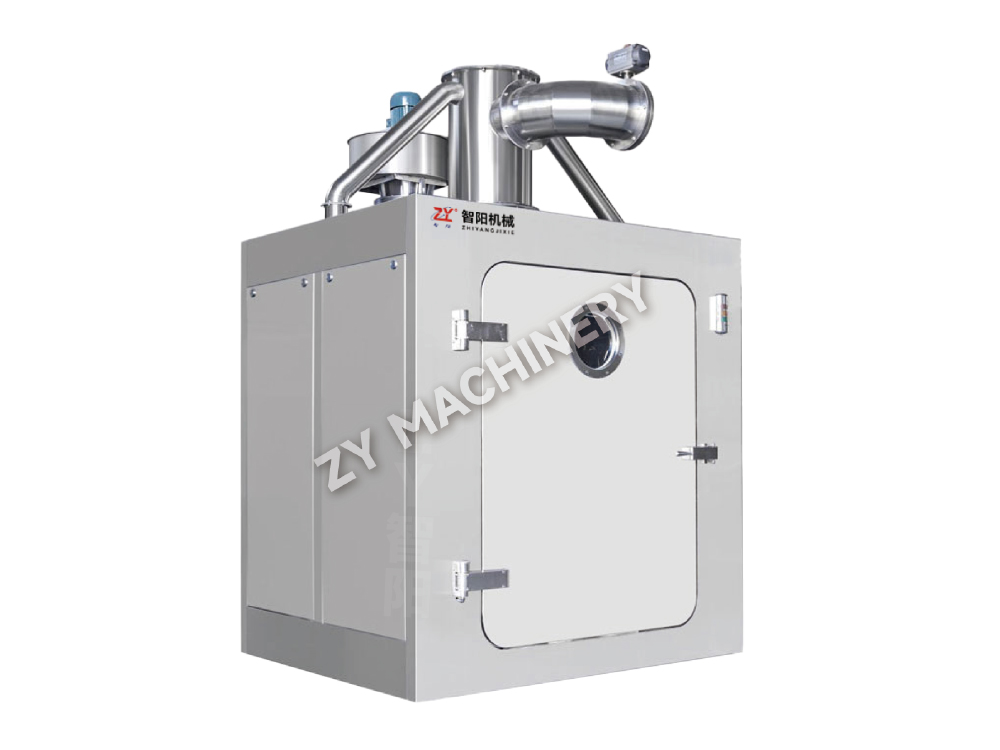
Drying is where a good granule can be ruined. Over-drying embrittles granules and creates fines; under-drying leaves moisture that destabilizes the API or causes sticking during compression. Fluid bed drying gives fast, uniform moisture removal and can be combined with granulation in a single unit, so granules are formed and dried without ever leaving a closed system. Vacuum drying is the better answer for heat-sensitive or solvent-based products, and hot air circulating ovens remain a practical choice for smaller and less critical batches.
 FL-B Fluid-bed Granulation & Drying Machine (One-Step Granulator)The FL-B Fluidized Bed Granulation Drying Machine is designed for powder handling, granulation, drying, and “top-spray” coating operations in pharmaceutical, food, and...View Product →
Coating does more than make a tablet look good. A film coat can mask taste, control release, protect the API from light and moisture, and improve swallowability. Perforated pan film coating machines dominate for tablets, while fluid bed coaters are used for granules, pellets, and particles. Whichever route is chosen, the practical questions stay the same: how uniform is the spray pattern, how stable is the pan or bed temperature, and how easily is the machine cleaned between products.
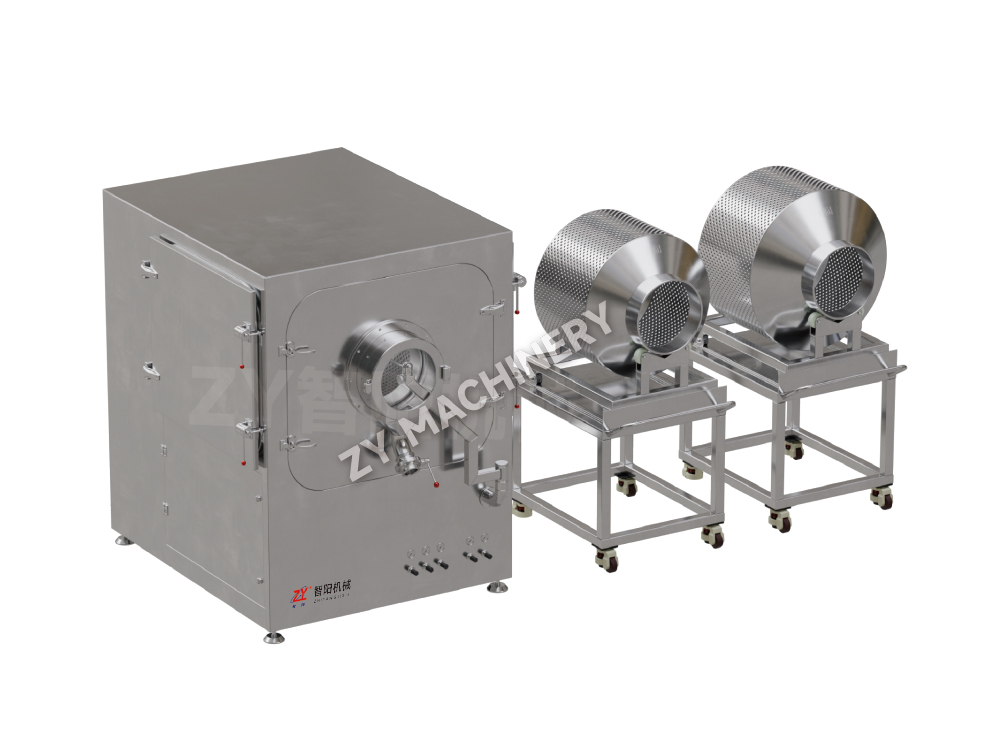 BGB High-Efficiency Film Coating MachineThe BGB R D High-Efficiency Coating Laboratory Machine is designed to meet laboratory-scale coating needs. It is mainly used in the pharmaceutical, food, and bioproduc...View Product →
Granules rarely leave a dryer at the right size. Milling and sizing machines break down oversize material and narrow the particle size distribution, while vibrating sieves remove oversize particles or foreign matter before compression. Small differences here reappear as weight variation and capping on the tablet press, so sizing equipment deserves the same attention as the more glamorous steps.
Scale-up is where many solid dosage projects stall. A formulation that behaves perfectly at 2 kg can behave unpredictably at 200 kg, because mixing efficiency, spray dynamics, and drying rates do not scale linearly.
The practical defence is to keep the same process logic across scales. Laboratory equipment built on the same working principles as production machines — the same impeller geometry, the same air handling pattern, the same granulation mechanism — gives development teams a realistic picture of what the larger unit will do, and shortens the technology transfer conversation considerably.
If you are working through that early stage, our notes on process development in solid dosage manufacturing cover the sequence in more detail.
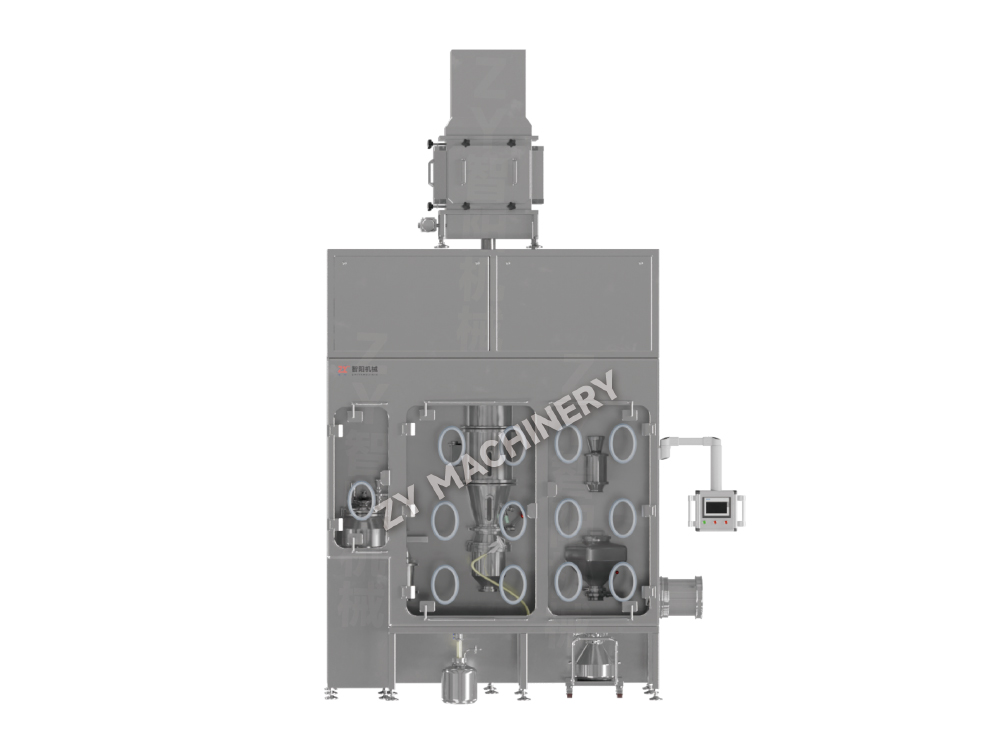
Modern OSD facilities increasingly handle highly potent compounds, and the equipment response is a contained line from start to finish. Dust-free feeding stations, closed transfer through bins and vacuum feeders, and suitable isolator or split-valve interfaces reduce operator exposure and keep cross-contamination under control.
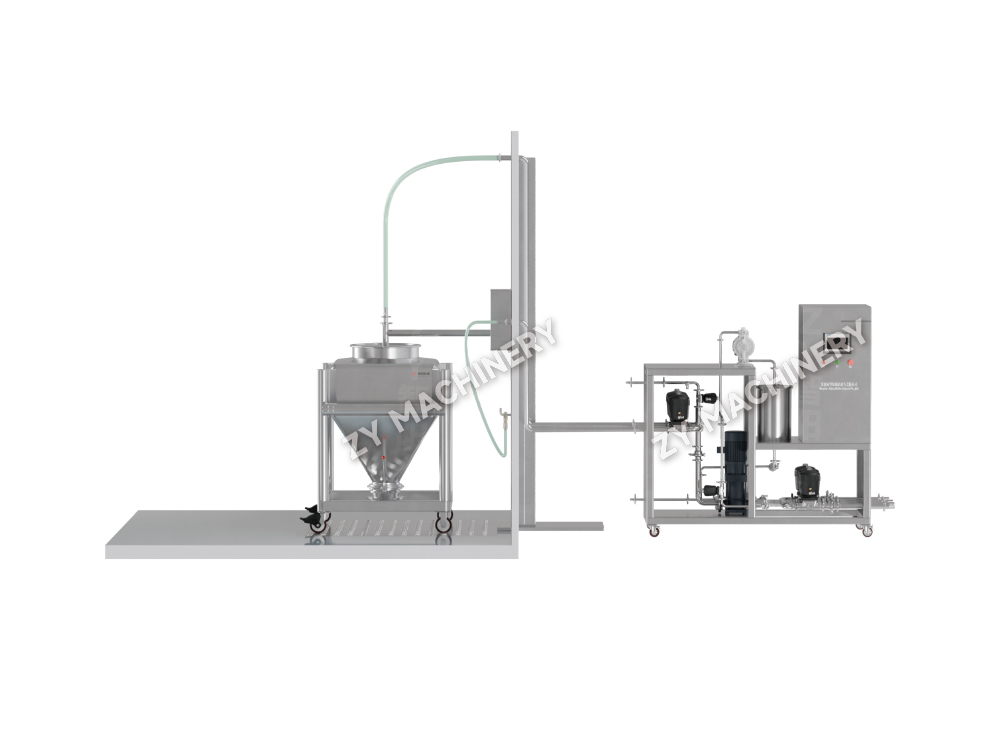
Cleaning is the other half of the story. Batch changeover time is often a bigger constraint on capacity than machine throughput, so automatic bin washing machines, mobile CIP stations, and easily dismantled product contact parts pay for themselves in released production hours. Decisions made at the equipment stage — surface finish, drainability, accessibility — determine how smoothly validation goes later.
Equipment lists are easy to compare; process support is not. A supplier who understands why a formulation needs fluid bed drying rather than a tray oven, or why a bin mixer outperforms a V-blender for a particular blend, will save more time across a project than a marginal price difference ever will.
When evaluating suppliers, ask for:
Because we build the line from the process backwards, that conversation usually starts with the material and the production target rather than a catalogue number. From laboratory units and high-containment systems to complete production lines for mixing, granulation, drying, coating, transfer, and cleaning, the goal is always the same: a route that works on day one and keeps working after scale-up.
Oral solid dosage manufacturing rewards preparation. Get the unit operations right, keep the process logic consistent from bench to production floor, and design containment and cleaning in from the start rather than patching them in later. Whether you are developing a first formulation or expanding an existing line, the equipment is only ever as good as the process thinking behind it.
Want to stay up to date?
Contact us via the email address below.
Don't worry about spam. We hate it too!
Mobile Client

Video Account
Phone:+86-15161130178
Tel:+86-519-88674267
Email:czzy188@163.com
Phone:+86-15161132798
Email:zy@zy-drying.com

WeChat ID

Copyright 2026 Changzhou Zhiyang Machinery Equipment Co., Ltd. All Rights Reserved  Oral Solid Dosage Equipment Manufacturer